Endocrine System: Key Glands & Functions
780 likes | 892 Views
Learn about major endocrine glands, hormone actions, and control mechanisms. Explore the roles of hypothalamus, pituitary, and thyroid in regulating body processes. Understand hormone disorders and their impacts.


Endocrine System: Key Glands & Functions
E N D
Presentation Transcript
Lesson 1 • Intro Major Glands & Functions • Hypothalamus • Pituitary (not enough time for all videos)
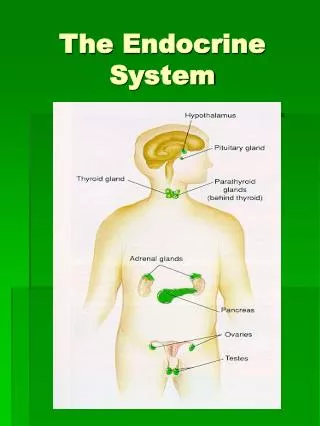
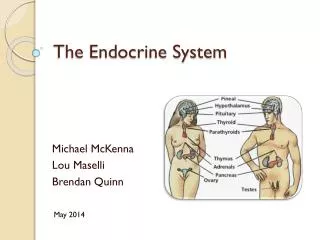
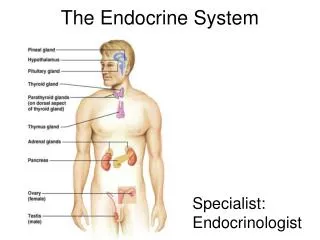
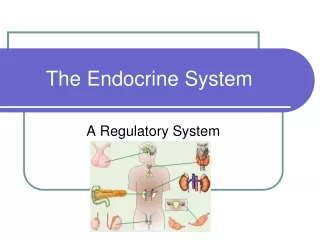
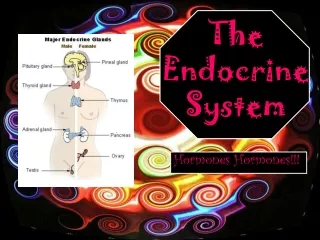
Location of Major Endocrine Organs Word Bank • Adrenal glands • Hypothalamus • Ovaries & Testes • Pancreas • Parathyroid glands • Pineal gland • Pituitary gland • Thymus gland • Thyroid gland Figure 9.3
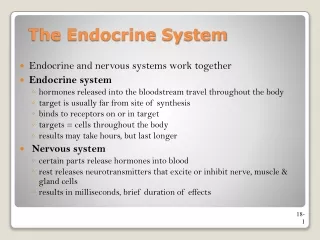
The Endocrine System • Uses chemical messengers called hormones that are released into the blood to target sites • Hormones control several major processes • Reproduction • Growth and development • Maintenance of homeostasis • Regulation of metabolism
Video - The Endocrine System (intro) Mechanisms of Hormone Action • Hormones affect only certain tissues or organs called target cells or organs • Target cells must have specific shaped protein receptors • Which is a target cell for both hormones? Why?
Control of Hormone Release • Hormone levels in the blood are mostly maintained by negative feedback • A stimulus or low hormone level in the blood triggers the release of more hormone • Hormone release stops once an appropriate level in the blood is reached • Endocrine glands are activated by other hormones • Example: Anterior pituitary hormones
Video - Hypothalamus & Pituitary Hypothalamus • Part of both the nervous and endocrine systems • Communicates with the pituitary gland with both releasing and inhibiting hormones
Pituitary Gland • Located in the brain, size of a pea • Has two functional lobes • Anterior & Posterior pituitary • Often called the “master endocrine gland” because it can affect other glands
Hormones of the Anterior Pituitary Figure 9.4
Anterior Pituitary Hormones • Six anterior pituitary hormones • Growth hormone • General metabolic hormone • Major effects are directed to growth of skeletal muscles and long bones • Plays a role in determining final body size • Causes amino acids to be built into proteins • Causes fats to be broken down for a source of energy
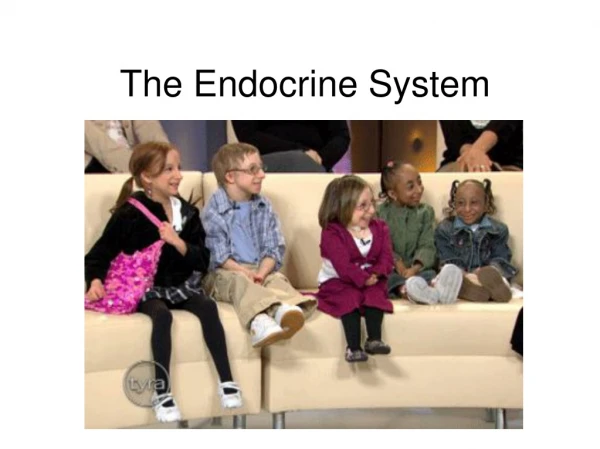
Hormones of the Anterior Pituitary • Growth hormone (GH) disorders • Dwarfism: hyposecretion of GH during childhood Video - Dwarfism Figure 9.5b
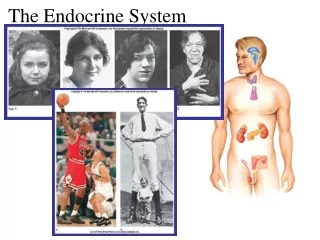
Hormones of the Anterior Pituitary • Gigantism: hypersecretion of GH during childhood Video - Gigantism (stop at 4:00)
Hormones of the Anterior Pituitary • Acromegaly: hypersecretion of GH during adulthood • Enlargement of facial bones, hands and feet Video - Acromegaly
Hormones of the Anterior Pituitary • Prolactin (PRL) • Stimulates and maintains milk production following childbirth • Adrenocorticotropic hormone (ACTH) • Regulates endocrine activity of the adrenal cortex • Thyroid-stimulating hormone (TSH) • Influences growth and activity of the thyroid gland
Hormones of the Anterior Pituitary • Gonadotropic hormones • Follicle-stimulating hormone (FSH) • Stimulates follicle development in ovaries • Stimulates sperm development in testes • Luteinizing hormone (LH) • Triggers ovulation of an egg in females • Stimulates testosterone production in males
Hormones of the Posterior Pituitary • Oxytocin • Stimulates contractions of the uterus during labor, sexual relations, and breastfeeding • Causes milk ejection (“let down”) in a nursing woman Video - Labor & Birth (animation)
Hormones of the Posterior Pituitary • Antidiuretic hormone (ADH) aka Vasopressin • Inhibits urine production by promoting water reabsorption by the kidneys • Causes vasoconstriction of vessels leading to increased blood pressure
Lesson 2 • Thyroid • Parathyroid • Adrenal
Endocrine System Diagram Worksheet Pituitary Parathyroid Thymus Thyroid Pancreas Adrenals Ovaries Testes
Hypothalamus & Pituitary Worksheet (pg 159) hypothalamus Hypophyseal fossa Turk’s saddle of sphenoid Anterior pituitary Posterior pituitary ACTH Growth hormone (GH) Prolactin (PRL) TSH FSH LH
Thyroid Gland • Found at the base of the throat • Consists of two lobes • Produces two hormones • Thyroid hormone (2 iodine based hormones: thyroxine & triiodothyronine, a.k.a. T4 & T3) • Major metabolic hormone, controls rate at which glucose is converted into energy • Calcitonin • Decreases blood calcium levels by causing its deposition on bone
Thyroid Gland Figure 9.7a
Thyroid Hormone Disorders • Goiters • Enlarged thyroid due to lack of iodine • Salt is iodized to prevent goiters Figure 9.8
Thyroid Hormone Disorders • Cretinism • Caused by hyposecretion of thyroxine • Results in dwarfism during childhood but body proportions remain childlike • If untreated can cause mental retardation
Thyroid Hormone Disorders • Myxedema • Caused by hypothyroidism in adults • Results in physical and mental sluggishness • Puffiness of face, poor muscle tone, dry skin
Thyroid Hormone Disorders • Graves’ disease • Caused by hyperthyroidism • Results in increased metabolism, heat intolerance, rapid heartbeat, weight loss, and exophthalmos (bulging protruding eyes) Figure 9.9
Video - Parathyroid glands & hyperparathyroidism Parathyroid Glands • Tiny masses on the posterior of the thyroid • Secrete parathyroid hormone (PTH) • Stimulates osteoclasts to remove calcium from bone to raise calcium levels in the blood
Calcitoninstimulatescalcium saltdepositin bone Calcitonin Thyroid glandreleasescalcitonin Thyroidgland RisingbloodCa2+ levels Imbalance FallingbloodCa2+levels Calcium homeostasis of blood9–11 mg/100 ml Imbalance Thyroidgland Parathyroidglands Parathyroidglands releaseparathyroidhormone (PTH) Osteoclastsdegrade bonematrix and releaseCa2+ into blood PTH Hormonal Regulation of Calcium in Blood Figure 9.10
Hormonal Regulation of Calcium in Blood • When blood calcium levels fall, the ___________ glands release _________________________, stimulating ____________ to degrade bone and release _________into the blood. • When blood calcium levels rise, the __________ gland releases ___________, stimulating calcium to be __________ in bone. parathyroid Parathyroid hormone (PTH) osteoclasts calcium thyroid calcitonin deposited
Hormonal Regulation of Calcium in Blood • Explain why this is an example of negative feedback. • Since both hormones involved in the feedback mechanism can be stimulated AND inhibited
Adrenal Glands • Located on top of the kidneys • Two regions • Adrenal cortex — outer glandular region • Adrenal medulla — inner neural tissue region
Hormones of the Adrenal Medulla • Produces two similar hormones • Epinephrine (adrenaline) • Norepinephrine (noradrenaline) • These hormones prepare the body to deal with short-term stress (“fight or flight”) by • Increasing heart rate, blood pressure, blood glucose levels • Dilating small passageways of lungs Video - Fight or Flight Response
Adrenal Gland Disorders • Addison’s disease • Hyposecretion of adrenal hormones • Bronze skin tone, muscles are weak, burnout, susceptibility to infection
Adrenal Gland Disorders • Hyperaldosteronism • May result from an ACTH-releasing tumor in anterior pituitary • Excess water and sodium are retained leading to high blood pressure and edema • May disrupt activity of heart & nervous system
Adrenal Gland Disorders • Cushing’s syndrome • Results from a tumor in the middle cortical area of the adrenal cortex • Swollen “moon face,” “buffalo hump” of fat on the upper back, high blood pressure, hyperglycemia, weakening of bones, depression
Masculinization • Results from hypersecretion of adrenal sex hormones (androgens) • Beard and male distribution of hair growth • Effects are masked in males, dramatic in females
Lesson 3 • Pancreas • Pineal • Thymus • Gonads • Placenta
Endocrine System & Hormone Function - An Overview Worksheet (pg 157) F slower & prolonged E nervous system B hormones D nerve impulses A cardiovascular system
Endocrine System & Hormone Function - An Overview Worksheet (pg 158) I receptors N target cells A altering activity L stimulating new K steroid or amino acid based G neural C hormonal D humoral F negative feedback B anterior pituitary J releasing hormones E hypothalamus H neuroendocrine
Pancreatic Islets • The pancreatic islets produce hormones • Insulin - produced by beta cells of pancreas • Allows glucose to cross plasma membranes into cells reducing blood sugar levels • Glucagon - produced by alpha cells of pancreas • allows stored glucose to enter the blood, raising blood sugar levels • These hormones are antagonists that maintain blood sugar homeostasis
Pancreatic Islets Figure 9.14a–b
Video - Blood sugar regulation Beta cells of the pancreasactivated; releaseinsulin into theblood Uptake of glucosefrom blood is enhanced in most body cells Blood glucoselevels declineto set point;stimulus forinsulin releasediminishes Elevatedblood sugarlevels Liver takes upglucose and storesit as glycogen Stimulus:rising bloodglucose levels(e.g., aftereating fourjelly doughnuts) Imbalance Stimulus: declining blood glucose levels(e.g., after skipping a meal) Homeostasis: Normal blood glucoselevels (90 mg/100ml) Imbalance Low bloodsugar levels Rising bloodglucose levelsreturn blood sugarto homeostatic setpoint; stimulus forglucagon releasediminishes Alpha cells of pancreasactivated; release glucagon into blood; target is the liver Liver breaks down glycogen stores and releases glucose to the blood Figure 9.15
Feedback Mechanism of the Liver & Pancreas • When blood glucose levels rise, _______ cells of the _____________ release the hormone _________ into the blood, causing body cells and the ______ to take up glucose and store it as glycogen. This brings blood glucose levels down to set point. • When blood glucose levels decline, __________ cells of the _____________ release the hormone ____________ into the blood, causing the liver to break down ___________ releasing glucose into the blood. This returns blood glucose levels to set point. beta pancreas insulin liver alpha glucagon pancreas glycogen
Feedback Mechanism of the Liver & Pancreas • Is this an example of positive feedback or negative feedback? How do you know? • Negative feedback because the responses can be both stimulated (increased) AND inhibited (decreased) to maintain homeostasis
Pancreas Disorders • Diabetes mellitus • Inability to regulate blood glucose levels • 3 signs of diabetes • Polyuria – excessive urination to flush out glucose & keytones (acidic product of fat metabolism) • Polydipsia – excessive thirst resulting from water loss • Polyphagia – hunger due to inability to use sugars
Pancreas Disorders • Diabetes mellitus (con’t) • Type 1 – Juvenile diabetes • More severe, inability to produce insulin • Insulin pump worn externally or administered by planned injections
Pancreas Disorders • Diabetes mellitus (con’t) • Type 2 – Adult onset diabetes • Insulin resistance (receptors don’t respond to insulin) • Controlled with diet or oral medications
Pineal Gland / Body • Secretes melatonin • Helps establish the body’s day-night cycles • Believed to coordinate the hormones of fertility in humans, inhibiting the reproductive system to prevent sexual maturation before adult body size is reached
Thymus Gland • Located posterior to the sternum • Largest in infants and children • Releases thymosin • Matures T-cells (a type of white blood cell) • Important in developing the immune system
Gonads • Ovaries (female gonad) • Produce eggs • Produce two groups of steroid hormones • Estrogens • Progesterone • Testes (male gonad) • Produce sperm • Produce androgens, such as testosterone