Download
1 / 8
80 likes | 200 Views
This comprehensive review covers essential concepts related to mass, density, and the physical and chemical properties of substances. Key discussions include measurement techniques, the significance of density, and the classification of elements based on their properties. The content clarifies distinctions between homogeneous and heterogeneous mixtures, explores valence electrons and their role in chemical bonding, and explains molecular geometry. Aimed at enhancing your grasp of basic scientific principles, this review supports students and educators in the field of chemistry.

E N D
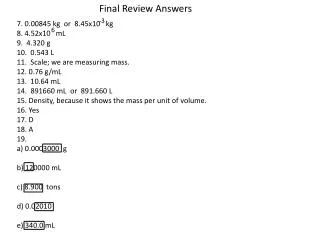
Final Review Answers -3 7. 0.00845 kg or 8.45x10 kg 8. 4.52x10 mL 9. 4.320 g 10. 0.543 L 11. Scale; we are measuring mass. 12. 0.76 g/mL 13. 10.64 mL 14. 891660 mL or 891.660 L 15. Density, because it shows the mass per unit of volume. 16. Yes 17. D 18. A 19. a) 0.0003000 g b) 120000 mL c) 8.900 tons d) 0.02010 e) 340.0 mL 6
20. a) 148.3 g b) 0.91 g c) 1 g d) 130000 m e) 0.9 g/mL 21. 4.30x10 g 22. 9.10x10 g 23. 3.22 g 24. 9.2000x10 g 25. 1.4x10 g 26. 6.372x10 g 27. 7.8x10 g 28. a) Physical b) Physical c) Chemical d) Physical e) Chemical f) Chemical -3 1 -1 4 -1 -1
29. b) Homogeneous c) Heterogeneous d) Heterogeneous e) Homogeneous f) Heterogeneous
30. a) b) c) 31. a) 1s2 2s2 2p6 3s2 3p6 4s2 3d6 b) 1s2 2s2 2p6 3s2 3p6 4s2 3d10 4p5 c) 1s2 2s2 2p6 3s2 3p6 4s2 3d10 4p6 5s2 32. d) Don’t do this one e) [Ne] 3s2 3p4 f) [Kr] 5s2 4d10 5p5 33. I am not boxing these in, but remember that valence electrons are the electrons in the highest energy level. ___ ___ ___ ___ ___ ___ ___ ___ ___ 1s 2s 2p 3s 3p ___ ___ ___ ___ ___ 1s 2s 2p ___ ___ ___ ___ ___ ___ ___ ___ ___ ___ ___ ___ ___ ___ ___ 1s 2s 2p 3s 3p 4s 3d
34. a) Alkali b) Alkaline c) Halogen d) Noble Gases 35. a) 6 b) 3 c) 4
36. a) Fe b) Sn c) As d) Cs 37. a) Zn b) I c) N d) Na 38. a) Zn b) I c) N d) Na 39. a) b) c)Don’t do this one 42. Trigonal pyramidal 43. Tetrahedral .. Cl P Cl Cl
44. a) Iron (III) oxide b) Magnesium nitrate c) Sodium hydroxide d) Diarsenicpentoxide e) Dinitrogen trioxide f) Iron (II) oxide g) Potassiam sulfate h) Phosphorus trichloride i) Potassium perchlorate 45. a) (NH )(OH) b) K(ClO ) c) NaI d) Li(NO ) e) Ca(NO ) f) Cu(SO ) g) N O h) NO i) CuBr 4 3 3 2 4 2 5
46. a) Gamma rays b) Blue light c) Microwaves 47. 4.2x10 J 48. 3.5x10 hz 49. Get behind concrete 50. a) b) 51. Protons & Neutrons 52. D 53. A 54. C 55. B -17 12 1 0 n 226 86 Rn