The Impact of Blacklisting and Cold War Policies on American Society in the 1940s and 1950s
This review examines the blacklisting phenomenon that devastated the careers of many in the film industry during the late 1940s and early 1950s, exploring its roots in anti-communist sentiments and McCarthyism. It also discusses the Eisenhower Doctrine's role as a strategic warning to the Soviet Union against military intervention in the Middle East. Furthermore, it investigates key figures who alleged a significant communist presence within the U.S. government and military, and outlines President Harry S. Truman's Fair Deal, a comprehensive economic proposal aimed at post-war recovery and social reform.

The Impact of Blacklisting and Cold War Policies on American Society in the 1940s and 1950s
E N D
Presentation Transcript
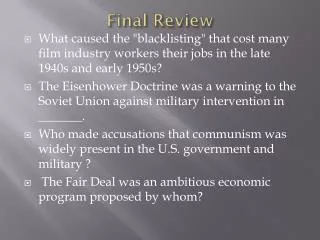
Final Review • What caused the "blacklisting" that cost many film industry workers their jobs in the late 1940s and early 1950s? • The Eisenhower Doctrine was a warning to the Soviet Union against military intervention in _______. • Who made accusations that communism was widely present in the U.S. government and military ? • The Fair Deal was an ambitious economic program proposed by whom?