MUL Instruction (Unsigned Multiply)
270 likes | 291 Views
Learn how to perform multiplication, division, and signed operations with examples of MUL, IMUL, DIV, IDIV instructions. Explore arithmetic expressions, overflow handling, and ways to manipulate binary values.


MUL Instruction (Unsigned Multiply)
E N D
Presentation Transcript
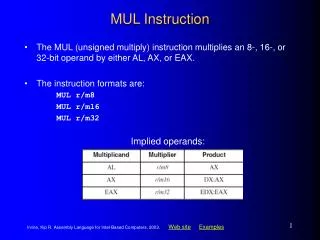
MUL Instruction(Unsigned Multiply) • Multiplies an 8-, 16-, or 32-bit operand by either AL, AX or EAX. MUL r/m8 MUL r/m16 MUL r/m32
MUL Instruction • Note that the product is stored in a register (or group of registers) twice the size of the operands. • The operand can be a register or a memory operand
MUL Examples Mov al, 5h Mov bl, 10h Mul bl ; AX = 0050h, CF = 0 (no overflow - the Carry flag is 0 because the upper half of AX is zero)
MUL Examples .data Val1 WORD 2000h Val2 WORD 0100h .code Mov ax, val1 Mul val2 ;DX:AX = 00200000h, CF = 1 (Carry flag is 1 because DX is not equal to zero)
IMUL Instruction(Signed Multiply) • Has the same syntax and uses the same operands as the MUL instruction except that it preserves the sign of the product.
IMUL Instruction • IMUL sets the Carry and Overflow flags if the high-order product is not a sign extension of the low-order product. Mov al, 48 Mov bl, 4 Imul bl ;AX = 00C0h, OF = 1 AH is not a sign extension of AL, so the Overflow flag is set.
IMUL Instruction Mul al, -4 Mov bl, 4 Imul bl ; AX = FFF0h, OF = 0 AH is a sign extension of AL (the signed result fits within AL), so the Overflow flag is clear.
DIV Instruction(Unsigned Divide) • Performs 8-, 16-, and 32-bit division on unsigned integers. DIV r/m8 DIV r/m16 DIV r/m32
DIV Examples8-bit Unsigned Division Mov ax,0083h ;dividend Mov bl, 2h ;divisor Div bl ; AL = 41h, AH = 01h Quotient is 41h, remainder is 1
DIV Examples Mov dx,0 ;clear dividend, high Mov ax, 8003h ;dividend, low Mov cx, 100h ;divisor Div cx ;ax = 0080h, dx = 0003h Quotient = 80h, remainder = 3
Signed Integer Division • CBW – convert Byte to word • Extends the sign bit of AL into the AH register .data Byteval SBYTE -65 .code mov al,byteval ; AL = 9Bh cbw ; AX = FF9Bh
Sign Extension Instructions • CBW • -Convert byte to word • CWD • Convert word to double • CDQ • -Convert double to quadword
IDIV Instruction(Signed Division) • Performs signed integer division, using the same operands as the DIV instruction • The dividend must be sign-extended into the high order register before IDIV executes.
IDIV Examples .data Byteval SBYTE -48 .code mov al, byteval ;dividend cbw ;extend AL into AH mov bl, 5 ;divisor idiv bl ;AL = -9, AH = -3
Divide Overflow • If the quotient is too large to fit into the destination operand, a divide overflow results. This causes a CPU interrupt, and the current program halts. Mov ax, 1000h Mov bl, 10h Div bl ;AL cannot hold 100h
DIV Overflow Can use 16-bit divisor to reduce the possibility of divide overflow. Mov ax, 1000h Mov dx, 0 ;clear DX Mov bx, 10h Div bx ;AX = 0100h
Dividing by Zero • Put a check of the divisor to compare to zero. If divisor is zero, jump to an error return and skip the code with the divide.
Implementing Arithmetic Expressions • Implement Var4 = (Var1 + Var2) * Var3 Mov eax,var1 Add eax, var2 Mul var3 ;EAX = EAX*Var3 Mov var4, eax
Extended Addition • How do you add 128-bit integers in C? • How do you add 128-bit integers in Assembly? • ADC (Add with Carry) • Adds both a source operand and the contents of the carry flag to a destination operand. Mov dl,0 Mov al, 0FFh Add al, 0FFh ;AL = FEh ADC dl,0 ;DL = 1
Subtract with Borrow • SBB • Subtracts both a source operand and the value of the carry flag from a destination operand. Mov edx, 1 ;upper half Mov eax, 0 ;lower half Sub eax,1 ;subtract 1 Sbb edx,0 ;subtract upper half
Adding ASCII Digits • ASCII values can be added digit by digit. It is slow, but allows processing of large numbers. • The high 4 bits of an unpacked decimal integer are always zero – they are always 0011 with ASCII
Necessary adjustments • AAA (ASCII Adjust after Addition) • Adjust the binary result of an ADD or ADC instruction. Mov ah,0 Mov al, ‘8’ ;AX = 0038h Add al, ‘2’ ;AX = 006Ah Aaa ;AX = 0100h Or ax, 3030h ;AX = 3130h = ’10’
Related Instructions • AAS • ASCII Adjust after Subtraction • AAM • ASCII Adjust after Multiplication • AAD • ASCII Adjust after Division
Packed Decimal Numbers • DAA Instruction • Decimal Adjust after Addtion • DAS Instruction • Decimal Adjsut after Subtraction