The Essential Steps to Becoming a Competent Writer: From Planning to Proofreading
Becoming a competent writer involves a systematic process that starts with planning your topic, generating ideas, and creating a strong thesis statement. You will need to shape your material by organizing it into a coherent structure with a clear introduction, body, and conclusion. The drafting phase allows you to put ideas into complete sentences and paragraphs. After drafting, you must revise for clarity and coherence before editing for technical correctness. Finally, proofreading ensures your work is polished and ready for submission, helping to achieve your writing goals.

The Essential Steps to Becoming a Competent Writer: From Planning to Proofreading
E N D
Presentation Transcript
Writing Process The steps to becoming a competent writer
Planning • What separates most good writing from bad is the writer’s ability to move back and forth between general statements and specific details.
Select a topic • Not too broad – leads to vague generalizations • Education is necessary for success. • Not too narrow – not enough supporting information • Mark Davis attends COTC.
Ask yourself …. • What is the paper’s purpose?
Generate ideas for your paper • Free writing • Brainstorming • Mapping/webbing – leads to a subject tree • Questioning (who, what, where, when, why, how) • Tape recording • Discuss with someone • Internet search • Idea book or journal • Incubate – let your ideas simmer for awhile
Shaping • You will organize your material, creating a beginning, a middle and an end. Set the stage, provide substance and end with a logical conclusion.
First step to shaping • Create a thesis statement • A thesis statement is the central message of your paper; • it is the main idea and should reflect the paper’s content.
Thesis statement requirements • States the essay’s subject • Conveys the essay’s purpose (informative or persuasive?) • Indicates the focus – your point of view • Uses specific language, appropriate words • May state major subdivisions of topic
Next step: creating an outline • Phrases or topic outline. • Sentence outline.
Next step: introductory paragraph • Includes the thesis statement. • Capture the reader’s attention and hold it!
Next step: body of paper • Where’s the beef?
Next step: paper’s conclusion • Restate your thesis statement in other words.
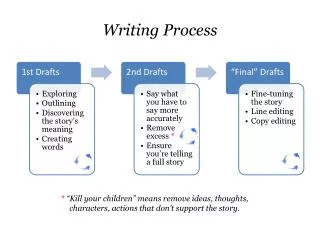
Draft • Drafting a paper means getting your ideas onto paper in complete sentences and paragraphs. • Set aside uninterrupted time and place. • Put ideas down on paper, just move forward. • Use complete sentences and form paragraphs.
Revise – re-vision • See your paper with new eyes. Ask how you can improve the paper. • Step away from your paper. • Add necessary words, paragraphs. • Cut anything that strays from topic. • Replace words, sentences, paragraphs. • Move paragraphs around; review the logical order. Make your ideas flow.
Edit • You will check for technical correctness during the editing process. • Check spelling. • Check punctuation. • Correct sentence structure. • Typographical errors. • Check for coherent thinking and writing. • Select appropriate words. • Write another draft.
Proofread • Use a fine-tooth comb to check your paper for accuracy and neatness. • Papers that look sloppy tend to obscure the message intended and can result in lower grades.
Proofreading tips • Ask others to read your work or read it aloud to you. • Use a ruler underneath each line to check for errors. • Read your paper backwards, sentence by sentence. • Read it aloud to someone else.