Download
1 / 4
40 likes | 154 Views
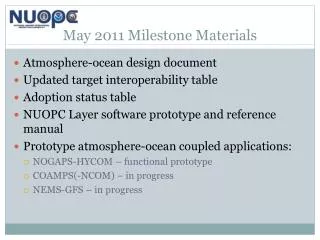
The May 2011 milestone document presents a comprehensive overview of the NUOPC Layer software prototype and its architectural design for improved atmosphere-ocean coupled applications. This document outlines the functionalities of various prototypes, including NOGAPS-HYCOM, COAMPS-NCOM, and NEMS-GFS. It emphasizes the establishment of a standardized framework for component interaction, including explicit coupling, inheritance from generic templates, and compliance checking. Detailed reporting mechanisms are introduced to facilitate troubleshooting and ensure smooth execution during model development.

E N D
May 2011 Milestone Materials • Atmosphere-ocean design document • Updated target interoperability table • Adoption status table • NUOPC Layer software prototype and reference manual • Prototype atmosphere-ocean coupled applications: • NOGAPS-HYCOM – functional prototype • COAMPS(-NCOM) – in progress • NEMS-GFS – in progress
Functions of prototype • Establish an architecture in which major components are siblings. The initial design supports explicit coupling and concurrent or sequential execution of components. • Allow inheritance from generic component templates. • Couple components with pre-fabricated connectors. • Standardize the number and function of phases of initialize, creating a standard setup pattern. • Constrain the data that may be sent between components with standardized field data structures and a field dictionary. • Implement a compliance checker to provide feedback during component development. • Use compatibility checking to determine if required import fields for a component were supplied. Other run-time reporting alerts users to any issues with compliance.
Interoperability impact • Component templates and generic connectors make it easier for modelers to create compliant systems since they can reuse existing code and patterns • Constraining and clearly defining initialize phases ensures that components fit into standard drivers. • Constraining Field data structuresand metadata ensures that the data communicated between components is understood • The ESMF layer ensures that components plug together into an executable application. The NUOPC layer reports when the components don't play together during execution. Detailed reporting provides the model developer with the insight necessary to debug and rectify code quickly.
More information See: http://www.earthsystemmodeling.org/plans/milestone_1105_nuopc.shtml For additional information on this milestone, including links to NUOPC Layer code, documentation, and supporting design documents.