Exploring What Makes Art: A Step-by-Step Guide to Creating Your Own Masterpiece
This guide investigates what defines an "artist" and what qualifies a piece as "art." Through a structured process, it encourages creativity by outlining a series of steps to create an artwork, starting from painting a large "X" to adding intricate details. Each step emphasizes critical elements such as line, shape, color, and texture, allowing artists to reflect on their creations and design principles like balance and unity. The process invites personal interpretation while evaluating artistic merit and individual expression.

Exploring What Makes Art: A Step-by-Step Guide to Creating Your Own Masterpiece
E N D
Presentation Transcript
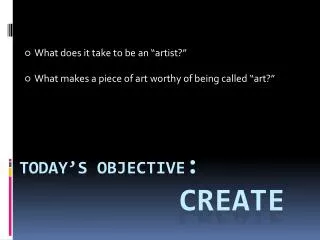
○ What does it take to be an “artist?” ○ What makes a piece of art worthy of being called “art?” Today’s Objective:CREATE
Step 1. Paint a Big “X” Consider the following for each and every step: • How big should it be? • Where should I place it on the paper? • How thick should it be? • Do the lines look rough or smooth? • Is each line the same thickness throughout or does it taper? • Is it symmetrical? • Is it tall and thin or short and wide? • Etc…..
Step 1. Paint a Big “X” Step 2. Paint 3 Circles
Step 1. Paint a Big “X” Step 2. Paint 3 Circles Step 3. Add horizontal lines
Step 1. Paint a Big “X” Step 2. Paint 3 Circles Step 3. Add horizontal lines Step 4. Create a Pattern
Step 1. Paint a Big “X” Step 2. Paint 3 Circles Step 3. Add horizontal lines Step 4. Create a Pattern Step 5. Fill in some dark areas
Step 1. Paint a Big “X” Step 2. Paint 3 Circles Step 3. Add horizontal lines Step 4. Create a Pattern Step 5. Fill in some dark areas Step 6. Add white paint for balance
Step 1. Paint a Big “X” Step 2. Paint 3 Circles Step 3. Add horizontal lines Step 4. Create a Pattern Step 5. Fill in some dark areas Step 6. Add white paint for balance Step 7. Add small “x” s
Step 1. Paint a Big “X” Step 2. Paint 3 Circles Step 3. Add horizontal lines Step 4. Create a Pattern Step 5. Fill in some dark areas Step 6. Add white paint for balance Step 7. Add small “x” s Step 8: Add small, active lines (toothbrush)
OPTIONAL: • Add touches of RED (Come to my desk for a small container of red paint and a detail brush) • Evaluate your overall design • Adjust and edit your artwork as needed
REFLECT: • Is it art? • Did you create? • Does it matter? • How is it similar to the artwork of your peers? • Now how is it different? • If you like it, why? • If you don’t like it, how could it be better?
Elements of Art Used: • LINE • SHAPE • VALUE • COLOR • SPACE • TEXTURE
Principles of Design Used: • Balance • Proportion • Rhythm • Emphasis • Unity