The Rise of Labor Unions: Strikes and Workers' Rights in the Industrial Era
Grim working conditions in various industries prompted workers to organize into unions and initiate strikes for better rights and working environments. Despite government policies like the Sherman Antitrust Act, businesses exerted little control over wealth distribution, leaving many workers in sweatshops, enduring long hours with no job security or paid leave. Early unions, initiated by shoemakers, carpenters, and industrial leaders like Terence V. Powderly and Samuel Gompers, marked significant efforts to negotiate changes. Key events include the Great Railroad Strike, the Haymarket Riot, and the Homestead and Pullman strikes, illustrating the tumultuous struggle for workers' rights.

The Rise of Labor Unions: Strikes and Workers' Rights in the Industrial Era
E N D
Presentation Transcript
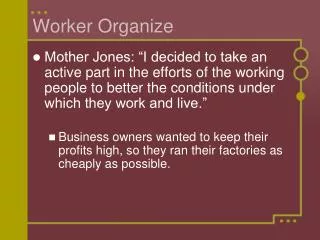
Ch.14; Sect. 3 STD: 2.4 Workers Organize
Main Idea • Grim working conditions in many industries led workers to form unions and stage labor strikes.
Government and Business • Sherman Antitrust Act • Def pg. 473 • Government policies had little effect on business • Unbalanced distribution of wealth • Rich were exceedingly rich
Industrial Workers • Workforce • European immigrants • White Americans from rural areas • Working conditions • 10 hr days • Six days a week • No paid vacation • Sweatshops • Cramped workshops in shabby tenement buildings
Why would workers agree to work in difficult conditions? • Lacked the skills to work elsewhere • Needed the jobs to survive
Workers Seek Change • Early organizing • 1794: Philadelphia shoemakers formed a trade union to protect their interests • Carpenters, printers, blacksmiths soon followed • National Unions • Knights of Labor • Leader- Terence V. Powderly • Hoped to achieve their ends without strikes by using boycotts and negotiating with employers
Workers Seek Changes (cont.) • Great Railroad strike- 1877 • 1st railroad strike • Haymarket Riot- 1886 • Haymarket Square in Chicago • Foreign-born unionists blamed • Xenophobia • Fear of foreigners
Workers Seek Change (cont.) • American Federation of Labor (FAL)-1886 • Founder • Samuel Gompers • Blacklists • Lists of people perceived as troublemakers
Workers Seek Changes (cont.) • Homestead Strike- 1892 • Carnegie Steel Company • Homestead, Pennsylvania • Workers refused to work faster • Manager tried to lock them out • Pullman Strike-1893 • Pullman Company • Union supporter • Eugene V. Debs • Urged members not to work on any trains that included Pullman cars
Follow-Up • Critical Thinking • Pg. 476; # 4