The Nervous System
The nervous system is divided into the central nervous system (CNS) and peripheral nervous system (PNS). The CNS, comprising the brain and spinal cord, processes sensory information and initiates motor control. The brain, weighing about 3 pounds, contains billions of neurons, vital for intellect, memory, and sensory processing. The unconscious brain controls essential functions like heart rate and reflexes, while the conscious brain governs higher intellect. The spinal cord is the communication superhighway connecting the brain to the body through complex neuronal pathways.

The Nervous System
E N D
Presentation Transcript
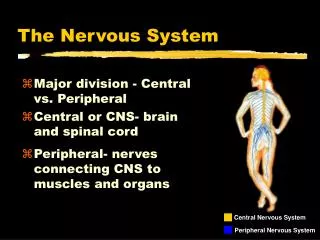
Central Nervous System • Includes the brain and spinal cord • Is where sensory information is received and motor (movement) control is initiated • Protected by • bone • Brain – skull • Spinal cord – vertebrae • 3 protective membranes called meninges • Space between meninges is cerebrospinal fluid (cushions and protects)
The Brain • Brain weighs about 3 pounds • Has hundreds of billions of neurons • You had the maximum number of neurons when you were born • 1000’s of neurons are lost every day and are never replaced • Don’t notice this until later in life when the loss is so large • This is why elderly people often become forgetful
The unconscious brain – parts of the brain that work without us thinking about them • Medulla oblongata • Closest to spinal cord • Controls heart rate, breathing, bp, reflex reactions (coughing, sneezing, vomiting, hiccupping, swallowing) • Thalamus • Receives sensory information (except for smell) from all parts of the body • Sends this info to the cerebrum for further processing • Cerebellum • Balance and complex muscular movement/coordination • Butterfly shaped • Receives sensory info from inner ear
hypothalamus • Regulation of homeostasis • Maintains internal environments • Detects hunger, sleep, thirst, body temp, water balance, bp • Controls the pituitary gland • Link between nervous system and endocrine (hormone) system • Responsible for fight or flight response • Pleasure centers located here • corpus callosum • Horizontal connecting piece between 2 halves of the brain • Transmits info between the right and left cerebral hemispheres
The conscious brain – The cerebrum • Largest most prominent, most highly developed part of the brain • Intellect, learning, memory and sensations are formed here • Divided into the right and left cerebral hemispheres • Right hemisphere controls the LEFT side of the body • Left hemisphere controls the RIGHT side of the body
Cerebral Lobes • Frontal lobe: movement, higher intellectual processing • Problem solving, concentration, planning, judging consequences • Parietal lobe: sensations • Touch, temperature, pressure, pain • Understanding speech and using words • Temporal lobe: hearing, smelling, interpreting experiences • Memory • Occipital lobe: vision
Spinal Cord • The “super highway” of the nervous system • Contains central canal filled with cerebrospinal fluid • Gray matter • Inner layer • Contains cell bodies of neurons • Looks like a butterfly with open wings • Cells bodies receive sensory information and send the motor information where it needs to go • White matter • Outer layer • Contains long fibers of internuerons bundled together in tracts • Tracts connect spinal cord to brain