Polychlorinated Biphenyls (PCBs) Impairment in San Francisco Bay: TMDL Overview and Management Actions
This document outlines the impairment of the San Francisco Bay due to Polychlorinated Biphenyls (PCBs), listing them on the 303(d) due to health advisories related to fish consumption. It details the Total Maximum Daily Loads (TMDLs) of PCBs, addressing sources such as atmospheric deposition, urban runoff, and sediment "hot spots." It also presents conceptual models for PCB movement in aquatic systems and proposes numeric targets for PCB levels in fish tissue and sediment. An adaptive management approach is suggested for effective implementation and monitoring.

Polychlorinated Biphenyls (PCBs) Impairment in San Francisco Bay: TMDL Overview and Management Actions
E N D
Presentation Transcript
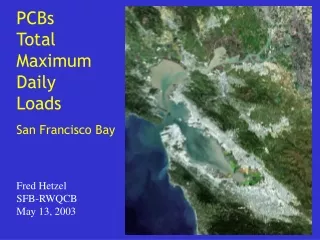
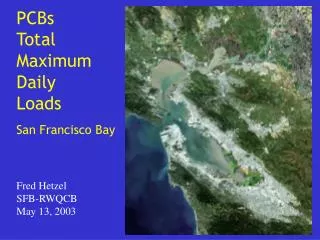
PCBs Total Maximum Daily Loads San Francisco Bay Fred Hetzel SFB-RWQCB May 13, 2003
Polychlorinated Biphenyls (PCBs) Impairment of San Francisco Bay • PCBs on 303(d) list due to interim health advisory for fish consumption • U.S. EPA California Toxics Rule-Human health risk assessment for fish consumption sets a total PCBs criteria in water at 0.00017 µg/L
PCBs Used in a Wide Range of Products • Closed applications • Capacitors and transformers • Heat transfer and hydraulic fluids • Open applications • Plasticizers • Surface coatings and paints • Flame retardants • Inks and adhesives • Pesticide extenders • Carbonless duplicating paper
TMDL Linkage Analysis • Link sources to endpoint • Pollutant fate, transport, and effects processes • Conceptual models
Generic Conceptual Model of PCBs Fate and Movement in Aquatic Systems (USEPA)
Bioturbation, Scouring, Deposition & Resuspension, Transport, Dredging Atmospheric Deposition PCBs TMDLConceptual Model Golden Gate Outflow PointSources Surface Waters UrbanRunoff Fish eatingWildlife Fish Spills & On-LandContaminated Sites Benthic & Plant eating Wildlife Biologically Active Sediment Layer Benthic Invertebrates & Plants Non-UrbanRunoff &Non-Point Sources Buried Sediment Layer Humans Degradation, Sorption & Desorption, Diffusion DeltaInflow (Adapted from SETAC, 2002)
Bioturbation, Scouring, Deposition & Resuspension, Transport, Dredging Atmospheric Deposition PointSources Golden Gate Outflow Surface Waters UrbanRunoff Spills & On-LandContaminated Sites Biologically Active Sediment Layer Non-UrbanRunoff &Non-Point Sources Buried Sediment Layer Degradation, Sorption & Desorption, Diffusion DeltaInflow Long Term Fate Model
Surface Waters Fish eatingWildlife Fish Benthic & Plant eating Wildlife Biologically Active Sediment Layer Benthic Invertebrates & Plants Buried Sediment Layer Humans Food Web Model
Proposed Numeric Targets for PCBs • Fish tissue = 23 parts per billion Based on human health risk assessment • Sediment = 2.5 parts per billion Based on generic bioaccumulation factors Not specific to San Francisco Bay
PCBs Sources to the Bay • Atmospheric deposition • In–Bay sediment “hot spots” • Dredging • Treated wastewater • Delta inflow • Urban runoff & on land “hot spots”
Proposed PCBs Allocations • Background and atmospheric deposition - 0 • Hot spots - Sediment target (phased approach) - Source investigations • Dredging - Sediment target (phased approach) - Source investigations • Treated effluent - Current mass • Run-off - Sediment target (phased approach) - Source investigations
Margin of Safety • MOS incorporated implicitly in the implementation and monitoring plans • Adaptive management approach to implementation
Sediment PCBs Concentrations • Target = 2.5 parts per billion • Current ambient = 20-35 parts per billion • Near-shore ambient = higher ?
Target? Target? TMDL Target(s) and Implementation Action Objective Effort ($,time,…)
TMDL Adaptive Implementation (NAS, 2001)
PCB TMDL Implementation • Immediate actions • High degree of certainty • Fixed time period • Monitoring program • Assess progress toward targets • Refine loading estimates • Studies (experiment ?) and model refinement • Validate key assumptions • Determine long term actions • Resolve key uncertainties ? • Review targets, allocations, and implementation