Download
1 / 32
320 likes | 459 Views
This analysis explores the performance of Kobe Bryant and Chris Bosh during the 2006-07 NBA season, focusing on their scoring averages, shot attempts, and success rates. Kobe averaged 31.6 PPG for the Los Angeles Lakers, showcasing his scoring prowess, while Chris Bosh averaged 26.3 PPG for the Toronto Raptors. The study utilizes the matching law to examine decision-making in basketball, emphasizing the influence of shot types (2-point vs. 3-point) on point maximization. We delve into the neural basis of the matching law and synaptic plasticity's role in reward-based learning.

E N D
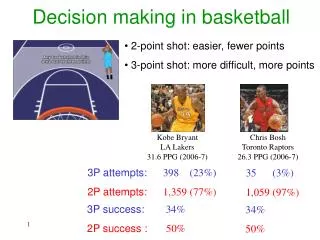
Kobe Bryant LA Lakers 31.6 PPG (2006-7) Chris Bosh Toronto Raptors 26.3 PPG (2006-7) 3P attempts: 398 (23%) 2P attempts: 1,359 (77%) 35 (3%) 1,059 (97%) 3P success:34% 2P success : 50% 34% 50% Decision making in basketball • 2-point shot: easier, fewer points • 3-point shot: more difficult, more points
The matching law NBA best 100 players (2006-2007) Bryant N2,3 = # of 2,3 points shots I2,3= # 2,3 points earned Bosh
The matching law 1 1 Herrnstein, JEAB, 1961
The matching law Sugrue, Corrado & Newsome, Science,2004
The matching law Gallistel et al., unpublished
The matching law Nj = # of attempts at alternative j investment inj Ij = # of points earned from alternative j income fromj equal returns
The matching law is very general. It is found in many animal types as well as humans, under very different experimental conditions.
Example: addiction model E[R|A=drugs] freq [drugs] 1–freq [work] after Herrnstein and Prelec, J Econ Perspect, 1991
matching Example: addiction model E[R|A=drugs] E[R|A=work] freq [drugs] 1–freq [work] after Herrnstein and Prelec, J Econ Perspect, 1991
Example: addiction model E[R|A=drugs] E[R|A=work] E[R] maximizing matching freq [drugs] 1–freq [work] after Herrnstein and Prelec, J Econ Perspect, 1991
Question: What is the neural basis of the matching law?
0.4 μm It is generally believed that learning is due to changes in the efficacy of synapses Kennedy, Science, 2000
Question: What is the neural basis of the matching law? Question: What microscopic plasticity rules underlie adaptation to matching behavior?
Question: What is the neural basis of the matching law? Hypothesis: the matching law results from synaptic plasticity that is driven by the covariance of reward and neural activity
Question: What is the neural basis of the matching law? Hypothesis: the matching law results from synaptic plasticity that is driven by the covariance of reward and neural activity
Covariance is a measure of dependence • two random variables X, Y • covariance: • correlation coefficient:
Hypothesis:the matching law results from synaptic plasticity that is driven by the covarianceof reward and neural activity
Synaptic plasticity • Local signals affect synaptic efficacies. Popular theory: Hebbain plasticity • Global signals affect synaptic efficacies. Popular theory: dopamine gates Hebbian plasticity (Wickens)
Synaptic plasticity • Local signals affect synaptic efficacies. Popular theory: Hebbain plasticity • Global signals affect synaptic efficacies. Popular theory: dopamine gates Hebbian plasticity (Wickens) • Popular theory: dopamine codes the mismatch between reward and expected reward (Schultz)
Average trajectory approximation Synaptic plasticity
Covariance-based plasticity rules N=Spre , N=Spost , N=SpreSpost Average trajectory approximation:
Hypothesis: covariance-based synaptic plasticity The matching law outline: Stationary state of covariance-based plasticity The matching law
Assumptions neurons N1 1. E[N|A=i] ≠E[N|A≠i] 2. The dependence of the reward R on neural activity N is through the action A. action reward N2 A R N3 N5 N4 hidden variables
Theorem Suppose that Assumptions 1 and 2 are satisfied The matching law
neuron action reward N A R Intuition • In general R depends on A • If, as a result of the policy used by the subject, R becomes independent of A then R also becomes independent of N
Summary Hypothesis: Covariance based synaptic plasticity underlies the matching law Theorem: The matching law Loewenstein & Seung, PNAS, 2006 Loewenstein, PLoS Comp Biol, 2008 Disclaimer: There are learning rules that converge to Cov[R,N]=0 that are not driven by covariance