Chem Catalyst Lab: Mass to Moles Conversion Practice
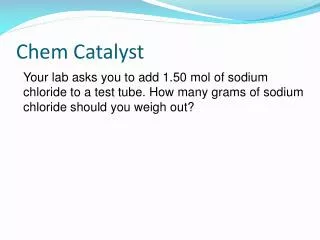
Your lab tasks you with adding 1.50 mol of sodium chloride to a test tube. Calculate the grams accurately using conversion formulas. Today's Agenda includes catalyst review, class practice on mole conversions, worksheet exercises, and a quiz preparation. Learn how to convert mass to moles with given examples and practice questions. Enhance your skills by calculating the masses and moles of different compounds.

Chem Catalyst Lab: Mass to Moles Conversion Practice
E N D
Presentation Transcript
Chem Catalyst Your lab asks you to add 1.50 mol of sodium chloride to a test tube. How many grams of sodium chloride should you weigh out?
Today’s Agenda: • Catalyst • Class practice- mole conversions • Worksheet practice • Quiz tomorrow!
Conversion: Mass to Moles • Multiply by (1 mol/ molar mass) • Ex: How many moles of iron (III) oxide are contained in 92.2g of Fe2O3?
Practice: • Calculate the mass, in grams, of 2.50 mol Fe(OH)2 • Find the mass of 3.00 mol of NaCl • Find the number of moles in 0.370 g of Boron. • Calculate the number of moles in 75.0 g of dinitrogen trioxide.