Calculating Moles of Chlorine for Iron(III) Chloride Production
This resource outlines the stoichiometric calculations necessary to determine the amount of chlorine gas needed to produce 14 moles of iron(III) chloride (FeCl3) from the reaction of iron (Fe) with chlorine (Cl2). It emphasizes the importance of balancing chemical equations and provides a framework for mole ratio conversions, including examples of converting grams to moles and vice versa. Additional practice problems enable students to apply these concepts in real-world scenarios, enhancing their understanding of stoichiometry in chemical reactions.

Calculating Moles of Chlorine for Iron(III) Chloride Production
E N D
Presentation Transcript
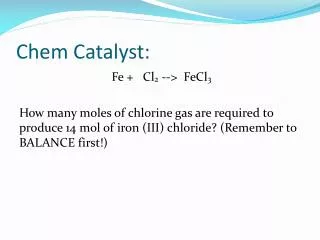
Chem Catalyst: Fe + Cl2 --> FeCl3 How many moles of chlorine gas are required to produce 14 mol of iron (III) chloride? (Remember to BALANCE first!)
Agenda: • Do Now- Mole ratios • Notes & Examples - adding grams to stoichiometry • HW: p. 361 #13, 14
Mole Ratios: Using grams *1. Convert value given in grams to moles 2. Mole ratio conversion *3. Convert answer in moles to grams Step 1: Only when the original measurement is in grams Step 3: Only when the goal of the problem is in grams
Example 1: N2 + 3H2 --> 2NH3 Calculate the number of grams of ammonia produced by the reaction of 5.40g of hydrogen with an excess of nitrogen.
Example 2: 2Cu+ O2 --> 2CuO Calculate how many grams of copper are needed to react completely with 12.5 mol of oxygen gas.
Example 3: 2Cu+ O2 --> 2CuO Calculate how many grams of copper are needed to produce exactly 20g of CuO.
Your turn: 2SO2 + O2 --> 2SO3 • How many grams of sulfur trioxide would be produced from the complete reactions of 8.0 mol of oxygen gas? • How many grams of sulfur dioxide are required to produce 10.0g of sulfur trioxide?