Download
1 / 16
160 likes | 269 Views
The scientific method is a systematic approach used by scientists to explore and understand the world around us through observation and experimentation. This process involves several key steps: identifying a problem, forming a hypothesis based on research, designing experiments to test the hypothesis, analyzing data, and finally communicating results. Understanding variables—independent, dependent, and control—is crucial for conducting effective experiments. The scientific method also encourages learning from outcomes, whether successful or not, fostering continuous improvement in scientific inquiry.

E N D
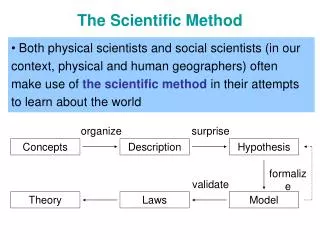
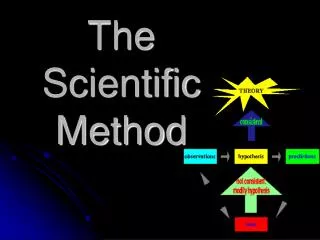
What is the scientific method? • Science is defined as observing, studying, and experimenting to gain a greater understanding of the world around us. • The scientific method is a system that helps scientists apply critical thinking in a way to solve problems.
Step 1: Identify the Problem • What do you want to know or explain? • Using your observations, write a question that addresses what you want to know or explain.
Step 2: Form a hypothesis • A hypothesis is more than just an educated guess about the outcome of the experiment. It’s an educated prediction. • Scientists do extensive research by reading research journals on similar topics. • This research could take many months before a hypothesis is created.
QUESTIONS? • Upcoming!! • How to design an experiment & learning to control your variables
Step 3: Designing An Experiment • This is where you test your hypothesis! • Scientists use experiments to • search for a cause and • effect relationship. • Experiments are designed • so that one item causes • something else to change. • These changing quantities • are called variables.
What are variables? • There are three types: independent variables, dependent variables, and control variables. • The independent variable: • Changed by the scientist • One per experiment • When altered, the scientist can observe what happens • The dependent variable: • Changes due to the independent variable • What is observed by scientists
What are variables? • The control variables: • Must remain constant (show no change) • All variables must be • measureable. • Ex. Love is not a • measureable variable.
Variable Examples • If you open a faucet • (ind. variable), the quantity • of water flowing (dep. variable) • changes in response. • If we want to measure how much water increases when we open the faucet, it is important to make sure that the water pressure (control variable) is held constant.
Step 4: Analyze your data & draw a conclusion • Does it support your hypothesis? • Is your data reliable? • If the hypothesis is supported, write your conclusion summarizing your important parts of your experiment and the results. • If your data is inconclusive or the experiment is flawed, write your conclusion like above.
Is an experiment ever thought of as a failure? • NO!!!! Step 5: Communicate your results! • Even if your hypothesis could not be proven or your experiment contained flaws, it’s a learning experience. • Redesign your experiment and rewrite your hypothesis. • Ex. The Sponge Bob’s cure for slimotosis
What is a Scientific Theory? • A theory is an explanation • that has been tested by repeated • observations. Theories are not • definite though. • Ex. Two hundred years ago, heat was thought to be an invisible fluid that flowed from a warm object to a cool object. • As technology advances, we are able to see our world more closely, make revisions, or change our theories if necessary.
What is a Scientific Law? • A law that states a repeated • observation about nature. • They are usually very simple. • Ex. Law of Gravity
Title Backdrop Slide Backdrop Print Backdrop Transitional Backdrop www.animationfactory.com Backdrops: - These are full sized backdrops, just double click them and size it up! Images: - Most of these .gifs, .jpgs, and .png images can be scaled up to fit your needs!