Understanding Logarithmic Functions and Their Applications in Calculus
This section explores logarithmic functions, their properties, and applications in calculus. It covers the definition of logarithms, including common and natural logarithms, and explains how to convert between exponential and logarithmic forms. The laws of logarithms are presented, enabling simplification of complex logarithmic expressions. Additionally, the section provides examples of solving exponential equations and includes problem assignments for practice. Mastery of these concepts is essential for deeper understanding in calculus and mathematical analysis.

Understanding Logarithmic Functions and Their Applications in Calculus
E N D
Presentation Transcript
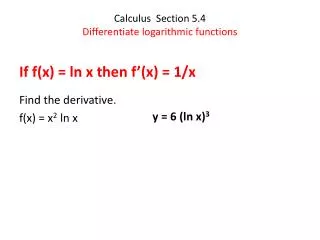
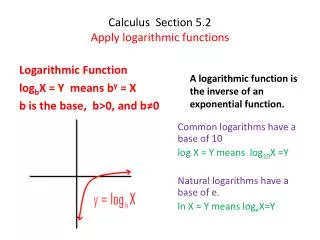
Calculus Section 5.2Apply logarithmic functions Logarithmic Function logbX = Y means by = X b is the base, b>0, and b≠0 A logarithmic function is the inverse of an exponential function. Common logarithms have a base of 10 log X = Y means log10X =Y Natural logarithms have a base of e. ln X = Y means logeX=Y
Write in exponential form. Write in logarithmic form. 25 = 32 e0 = 1 10-3 = .001 log3 9 = 2 log 1000 = 3 ln x = t
Laws of Logarithms • log X + log Y = log(XY) • log X – log Y = log (X/Y) • X log Y = log(Yx) Express as a single logarithm. log 4 + log A – 2 log B ln e5 4 log3 3
Solve the exponential equation. 3e2x + 2 = 14 2 ln x = 4
assignment Page 272 Problems 2-32 even,45,46,47,49,51,54,56,58