Understanding Relations and Functions: Domain, Range, and Function Evaluation
This section focuses on identifying relations and functions, determining their domains and ranges, and evaluating functions. A relation consists of a set of ordered pairs, while a function uniquely pairs each domain value with one range value. Key methods for identifying functions include graph analysis and the vertical line test. Examples illustrate how to find domains and ranges, verify functions using graphs, and evaluate function rules using inputs. This material is essential for mastering the fundamentals of algebraic relations and functions.

Understanding Relations and Functions: Domain, Range, and Function Evaluation
E N D
Presentation Transcript
Section 5.2: Relations and Functions Objectives: To identify relations and functions To find the domain and range of a relation and a function To evaluate functions
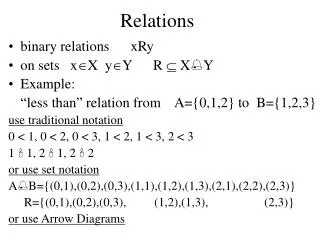
Relation: A set of ordered pairs Example: Ordered Pairs: (2, 0) (12, 1) (18, 1) (7, 2)
Domain: Set of first coordinates of the ordered pair Range: Set of second coordinates Ordered Pairs: (2, 0), (12, 1), (18, 1), (7, 2) Domain: {2, 7, 12, 18} Range: {0, 1, 2}
Example Find the domain and range of the relation represented by the data in the table. Domain: Range:
Function: A relation that pairs each domain value with exactly one range value *Each x value can only correspond to ONE y value Ways to determine if a relation is a function: • Graph • Mapping
Vertical Line Test If any vertical line passes through more than one point of the graph, the relation isn’t a function. Examples: Graph the ordered pairs and determine if the relation is a function by using the vertical line test. • {(3, 2), (5, -1), (-5, 3), (-2, 2)} • {(4, 3), (2, -1), (-3, -3), (2, 4)}
Mapping • List the domain and range values in order. • If a number appears more than once, only write it once. • Draw lines from the domain values to their range values • If every domain value pairs up with only one range value, then the relation is a function Examples: {(-1, 2), (0, 3), (4, 3), (0, 5)} {(4, 5), (1, 0), (3, 0), (2, -2)}
Function Rule • An equation that describes a function Example: y = 5x + 8 x = input y= output When given input values you can use the function rule to find the output values.
y = 5x + 8 InputOutput 0 1 2
Function Notation Another way to write y = 5x + 8 is f(x) = 5x + 8 • A function is in function notation when you use f(x) to indicate the outputs. • f(x) is read as “f of x” or “f is a function of x”
Evaluating a Function Rule • Evaluate f(x) = -5x + 25 for x = -2 • Evaluate g(x) = 4x2 + 2 for x = 3
Finding the Range • Remember: input values = domain output values = range Example: Evaluate the function f(g) = -2g + 4 to find the range for the domain {-1, 3, 5}