Understanding Eigenvalues and Eigenvectors in Linear Algebra
540 likes | 1.27k Views
Explore the concepts of eigenvalues and eigenvectors, diagonalization of matrices, and orthogonal diagonalization in elementary linear algebra. Learn about symmetric matrices and their properties in relation to eigenvalues. Understand the geometric interpretation of eigenvectors and their impact on linear transformations.


Understanding Eigenvalues and Eigenvectors in Linear Algebra
E N D
Presentation Transcript
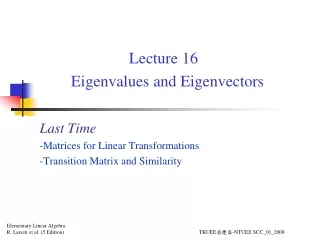
Lecture 16 Eigenvalues and Eigenvectors Last Time -Matrices for Linear Transformations -Transition Matrix and Similarity Elementary Linear Algebra R. Larsen et al. (5 Edition) TKUEE翁慶昌-NTUEE SCC_01_2008
Lecture 16: Eigenvalues and Eigenvectors Today • Eigenvalues and Eigenvectors • Diagonalization • Symmetric Matrices and Orthogonal Diagonalization Reading Assignment: Chapter 7
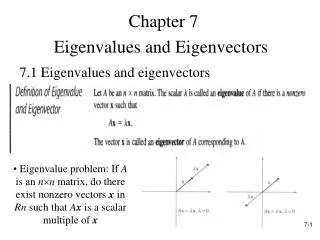
Geometrical Interpretation Eigenvalue Eigenvector 7.1 Eigenvalues and Eigenvectors • Eigenvalue problem: If A is an nn matrix, do there exist nonzero vectors x in Rn such that Ax is a scalar multiple of x? • Eigenvalue and eigenvector: A:an nn matrix :a scalar x: a nonzero vector in Rn 16- 3
Eigenvalue Eigenvalue Eigenvector Eigenvector • Ex 1: (Verifying eigenvalues and eigenvectors) 16- 4
Pf: x1 and x2are eigenvectors corresponding to • Thm 7.1: (The eigenspace of A corresponding to ) If A is an nn matrix with an eigenvalue, then the set of all eigenvectors of together with the zero vector is a subspace of Rn. This subspace is called the eigenspace of . 16- 5
If For a vector on the x-axis Eigenvalue • Ex 3: (An example of eigenspaces in the plane) Find the eigenvalues and corresponding eigenspaces of Sol: 16- 6
Eigenvalue The eigenspace corresponding to is the x-axis. The eigenspace corresponding to is the y-axis. For a vector on the y-axis Geometrically, multiplying a vector (x, y) in R2by the matrix A corresponds to a reflection in the y-axis. 16- 7
Note: (homogeneous system) • Characteristic polynomial of AMnn: If has nonzero solutions iff . • Characteristic equation of A: • Thm 7.2: (Finding eigenvalues and eigenvectors of a matrix AMnn ) Let A is an nn matrix. (1) An eigenvalue of A is a scalar such that . (2) The eigenvectors of A corresponding to are the nonzero solutions of . 16- 8
Eigenvalue: • Ex 4: (Finding eigenvalues and eigenvectors) Sol: Characteristic equation: 16- 9
Sol: Characteristic equation: Eigenvalue: • Ex 5: (Finding eigenvalues and eigenvectors) Find the eigenvalues and corresponding eigenvectors for the matrix A. What is the dimension of the eigenspace of each eigenvalue? 16- 11
The eigenspace of A corresponding to : Thus, the dimension of its eigenspace is 2. 16- 12
Notes: (1) If an eigenvalue 1 occurs as a multiple root (k times) for the characteristic polynominal, then1 has multiplicity k. (2) The multiplicity of an eigenvalue is greater than or equal to the dimension of its eigenspace. 16- 13
Sol: Characteristic equation: Eigenvalue: • Ex 6:Find the eigenvalues of the matrix A and find a basis for each of the corresponding eigenspaces. 16- 14
Ex 7: (Finding eigenvalues for diagonal and triangular matrices) Sol: • Thm 7.3: (Eigenvalues for triangular matrices) If A is an nn triangular matrix, then its eigenvalues are the entries on its main diagonal. 16- 18
Eigenvalues and eigenvectors of linear transformations: 16- 19
Keywords in Section 7.1: • eigenvalue problem: 特徵值問題 • eigenvalue: 特徵值 • eigenvector: 特徵向量 • characteristic polynomial: 特徵多項式 • characteristic equation: 特徵方程式 • eigenspace: 特徵空間 • multiplicity: 重數 16- 20
Lecture 16: Eigenvalues and Eigenvectors Today Eigenvalues and Eigenvectors Diagonalization Symmetric Matrices and Orthogonal Diagonalization 16- 21
Notes: (1) If there exists an invertible matrix P such that , then two square matrices A and B are called similar. (2) The eigenvalue problem is related closely to the diagonalization problem. 7.2 Diagonalization • Diagonalization problem: For a square matrix A, does there exist an invertible matrix P such that P-1AP is diagonal? • Diagonalizable matrix: A square matrix A is called diagonalizable if there exists an invertible matrix P such that P-1AP is a diagonal matrix. (P diagonalizes A) 16- 22
Pf: • Thm 7.4: (Similar matrices have the same eigenvalues) If A and B are similar nn matrices, then they have the same eigenvalues. Thus A and B have the same eigenvalues. 16- 23
Sol: Characteristic equation: • Ex 1: (A diagonalizable matrix) 16- 24
Note: If 16- 25
Pf: • Thm 7.5: (Condition for diagonalization) An nn matrix A is diagonalizable if and only if it has n linearly independent eigenvectors. 16- 26
Sol: Characteristic equation: • Ex 4: (A matrix that is not diagonalizable) A does not have two linearly independent eigenvectors, so A is not diagonalizable. 16- 29
Step 2: Let Step 3: • Steps for diagonalizing an nn square matrix: Step 1: Find n linearly independent eigenvectors for A with corresponding eigenvalues. 16- 30
Sol: Characteristic equation: • Ex 5: (Diagonalizing a matrix) 16- 31
Notes: 16- 34
Ex 7: (Determining whether a matrix is diagonalizable) Sol: Because A is a triangular matrix, its eigenvalues are These three values are distinct, so A is diagonalizable. • Thm 7.6: (Sufficient conditions for diagonalization) If an nn matrix A has n distinct eigenvalues, then the corresponding eigenvectors are linearly independent and A is diagonalizable. 16- 35
Sol: • Ex 8: (Finding a diagonalizing matrix for a linear transformation) From Ex. 5 you know that A is diagonalizable. Thus, the three linearly independent eigenvectors found in Ex. 5 can be used to form the basis B. That is 16- 36
Keywords in Section 7.2: • diagonalization problem: 對角化問題 • diagonalization: 對角化 • diagonalizable matrix: 可對角化矩陣 16- 38
Lecture 16: Eigenvalues and Eigenvectors Today Eigenvalues and Eigenvectors Diagonalization Symmetric Matrices and Orthogonal Diagonalization 16- 39
Ex 1: (Symmetric matrices and nonsymetric matrices) 7.3 Symmetric Matrices and Orthogonal Diagonalization • Symmetric matrix: A square matrix A is symmetric if it is equal to its transpose: (symmetric) (symmetric) (nonsymmetric) 16- 40
Thm 7.7: (Eigenvalues of symmetric matrices) If A is an nn symmetric matrix, then the following properties are true. (1) A is diagonalizable. (2) All eigenvalues of A are real. (3) If is an eigenvalue of A with multiplicityk, then has k linearly independent eigenvectors. That is, the eigenspace of has dimensionk. 16- 41
Pf: Characteristic equation: As a quadratic in , this polynomial has a discriminant of • Ex 2: Prove that a symmetric matrix is diagonalizable. 16- 42
The characteristic polynomial of A has two distinct real roots, which implies that A has two distinct real eigenvalues. Thus, A is diagonalizable. 16- 43
Thm 7.8: (Properties of orthogonal matrices) An nn matrix P is orthogonal if and only if its column vectors form an orthogonal set. • Thm 7.9: (Properties of symmetric matrices) Let A be an nn symmetric matrix. If1 and 2 are distinct eigenvalues of A, then their corresponding eigenvectors x1 and x2 are orthogonal. • Orthogonal matrix: A square matrix P is called orthogonal if it is invertible and 16- 44
Sol: If P is aorthogonal matrix, then • Ex 5: (An orthogonal matrix) 16- 45
Orthogonal diagonalization of a symmetric matrix: Let A be an nn symmetric matrix. (1) Find all eigenvalues of A and determine the multiplicity of each. (2) For each eigenvalue of multiplicity 1, choose a unit eigenvector. (3) For each eigenvalue of multiplicity k2, find a set of k linearly independent eigenvectors. If this set is not orthonormal, apply Gram-Schmidt orthonormalization process. (4) The composite of steps 2 and 3 produces an orthonormal set of n eigenvectors. Use these eigenvectors to form the columns of P. The matrix will be diagonal. • Thm 7.10: (Fundamental theorem of symmetric matrices) Let A be an nn matrix. Then A is orthogonally diagonalizable and has real eigenvalue if and only if A is symmetric. 16- 47
Ex 7: (Determining whether a matrix is orthogonally diagonalizable) Symmetric matrix Orthogonally diagonalizable 16- 48
Sol: Linear Independent • Ex 9: (Orthogonal diagonalization) 16- 49
Gram-Schmidt Process: 16- 50