Download
1 / 34
340 likes | 456 Views
Explore Mendelian genetics principles and bacterial reproduction mechanisms, including Gregor Mendel’s contributions and genetic variation through sexual reproduction in organisms. Understand the inheritance patterns and terminology through Mendel’s pea plant experiments.

E N D
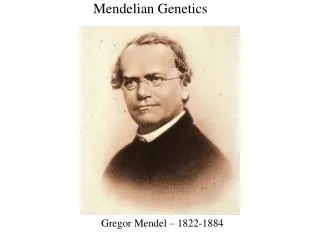
Mendelian Genetics Gregor Mendel – 1822-1884
Asexual Reproduction • Bacteria can reproduce as often as every 12 minutes – and may go through 120 generations in one day • Thus capable of producing 6 x 1035 offspring per day • Bacteria often produce 1 mutation per 1000 replications of DNA • So for fast-growing species, mutation is a good way to respond to a changing environment
Why Sex? John Maynard Smith
Sexual reproduction leads to genetic variation via: • Independent assortment during meiosis • Crossing over during meiosis • Random mixing of gametes (sperm and egg)
Prophase Iof meiosis Nonsister chromatidsheld togetherduring synapsis Pair of homologs Chiasma Centromere TEM Anaphase I Anaphase II Daughtercells Recombinant chromosomes
The random nature of fertilization adds to the genetic variation arising from meiosis. • Any sperm can fuse with any egg. • A zygote produced by a mating of a woman and man has a unique genetic identity. • An ovum is one of approximately 8,388,608 possible chromosome combinations (223). • The successful sperm represents one of 8,388,608 different possibilities (223). • The resulting zygote is composed of 1 in 70 trillion (223 x 223) possible combinations of chromosomes. • Crossing over adds even more variation to this.
Mendelian Genetics Gregor Mendel – 1822-1884
Two possible types of inheritance • One possible explanation of heredity is a “blending” hypothesis • The idea that genetic material contributed by two parents mixes in a manner analogous to the way blue and yellow paints blend to make green • An alternative to the blending model is the “particulate” hypothesis of inheritance: the gene idea • Parents pass on discrete heritable units, later known as genes
Mendel’s time Today Mendel’s garden at Brunn (Brno) Monastery
Some genetic vocabulary • Character: a heritable feature, such as flower color • Trait: a variant of a character, such as purple or white flowers Garden Pea
3 2 1 4 5 TECHNIQUE Parentalgeneration(P) Stamens Carpel RESULTS First filialgenerationoffspring(F1)
In Mendel’s Experiments: • Mendel chose to track • Only those characters that varied in an “either-or” manner • Mendel also made sure that • He started his experiments with varieties that were “true-breeding” • In a typical breeding experiment • Mendel mated two contrasting, true-breeding varieties, a process called hybridization
Breeding Terminology • The true-breeding parents • Are called the P (parental) generation • The hybrid offspring of the P generation • Are called the F1 (filial) generation • When F1 individuals self-pollinate • The F2 generation is produced
EXPERIMENT P Generation (true-breedingparents) Purpleflowers Whiteflowers
EXPERIMENT P Generation (true-breedingparents) Purpleflowers Whiteflowers F1 Generation(hybrids) All plants had purple flowers Self- or cross-pollination
EXPERIMENT P Generation (true-breedingparents) Purpleflowers Whiteflowers F1 Generation(hybrids) All plants had purple flowers Self- or cross-pollination F2 Generation 705 purple-floweredplants 224 whitefloweredplants
Mendel developed a hypothesis to explain his results that consisted of four ideas • Alternative versions of genes (different alleles) account for variations in inherited characters • For each character, an organism inherits two alleles, one from each parent • If two alleles differ, then one, the dominant allele, is fully expressed in the organism’s appearance. The other, recessive allele has no effect on a hybrid organism’s appearance • The two alleles for each character segregate (separate) during gamete formation
P Generation Appearance: White flowers Purple flowers Genetic makeup: pp PP p Gametes: P Law of Segregation
P Generation Appearance: White flowers Purple flowers Genetic makeup: pp PP p Gametes: P Law of Segregation F1 Generation Appearance: Purple flowers Genetic makeup: Pp p 1/2 1/2 P Gametes:
P Generation Appearance: White flowers Purple flowers Genetic makeup: pp PP p Gametes: P Law of Segregation F1 Generation Appearance: Purple flowers Genetic makeup: Pp p 1/2 1/2 P Gametes: Sperm from F1 (Pp) plant F2 Generation p P P Pp PP Eggs from F1 (Pp) plant p pp Pp 3 : 1
Genotype Phenotype PP(homozygous) Purple 1 Pp(heterozygous) 3 Purple 2 Pp(heterozygous) Purple pp(homozygous) White 1 1 Ratio 3:1 Ratio 1:2:1
TECHNIQUE Dominant phenotype,unknown genotype:PP or Pp? Recessive phenotype,known genotype:pp Predictions Test cross If purple-floweredparent is PP or If purple-floweredparent is Pp Sperm Sperm p p p p P P Pp Pp Pp Pp Eggs Eggs P p pp pp Pp Pp RESULTS or All offspring purple 1/2 offspring purple and1/2 offspring white
EXPERIMENT YYRR yyrr P Generation Gametes yr YR F1 Generation YyRr Hypothesis ofdependent assortment Predictions Hypothesis ofindependent assortment Sperm or Predictedoffspring ofF2 generation 1/4 1/4 1/4 1/4 yR yr Yr YR Sperm 1/2 YR 1/2 yr 1/4 YR YYRR YYRr YyRR YyRr 1/2 YR YyRr YYRR 1/4 Yr Eggs YYRr YYrr Yyrr YyRr Eggs 1/2 yr YyRr yyrr 1/4 yR YyRr yyRr YyRR yyRR 3/4 1/4 yr 1/4 Phenotypic ratio 3:1 Yyrr yyRr YyRr yyrr 3/16 3/16 1/16 9/16 Phenotypic ratio 9:3:3:1 RESULTS 108 101 315 Phenotypic ratio approximately 9:3:3:1 32
Rr Rr Segregation ofalleles into sperm Segregation ofalleles into eggs Sperm r 1/2 1/2 R R R r R R 1/2 1/4 1/4 Eggs r r r R 1/2 r 1/4 1/4
1/4 (probability of YY) 1/4 (RR) 1/16 Probability of YYRR Probability of YyRR 1/4 (RR) 1/2 (Yy) 1/8
1/4 (probability of YY) 1/4 (RR) 1/16 Probability of YYRR Probability of YyRR 1/4 (RR) 1/2 (Yy) 1/8 Probability of yyrr = ? A. 1/8 B. 1/16 C. 1/32
1/4 (probability of YY) 1/4 (RR) 1/16 Probability of YYRR Probability of YyRR 1/4 (RR) 1/2 (Yy) 1/8 Probability of YYrr = ? A. ¼ B. 1/8 C. 1/16
1/4 (probability of YY) 1/4 (RR) 1/16 Probability of YYRR Probability of YyRR 1/4 (RR) 1/2 (Yy) 1/8 Probability of YxRr = ? (x can be Y or y) A. ½ B. 3/4 C. 3/8 D. 1/16
1/4 (probability of pp) 1/2 (yy) 1/2 (Rr) 1/16 ppyyRr 1/16 ppYyrr 1/41/21/2 2/16 Ppyyrr 1/21/21/2 1/16 1/41/21/2 PPyyrr ppyyrr 1/16 1/41/21/2 6/16 or 3/8 Chance of at least two recessive traits