Optimizing with the Simplex Method: A Geometric Approach
This document explores the Simplex Method, a powerful algorithm for solving linear programming problems. It illustrates the concept of walking on the vertices of the feasible region to find optimal solutions defined by a series of inequalities. The process is broken down step by step, highlighting how to make variable adjustments for maximizing objective functions, also discussing geometric interpretations of the Simplex method. Key examples illustrate how to determine optimal points while ensuring constraints are met.

Optimizing with the Simplex Method: A Geometric Approach
E N D
Presentation Transcript
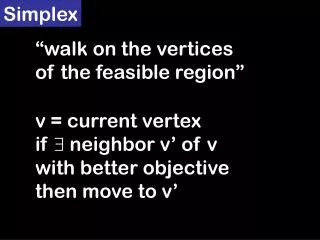
Simplex “walk on the vertices of the feasible region” v = current vertex if neighbor v’ of v with better objective then move to v’
Simplex “walk on the vertices of the feasible region” vertex = feasible point defined by a collection of d inequalities neighbors = vertices sharing d-1 of the inequalities
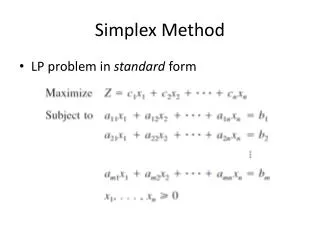
v = current vertex if neighbor v’ of v with better objective then move to v’ Simplex max cT x Ax b x 0 assume v = (0,...,0)T i such that ci > 0 iff v is not optimal
v = current vertex if neighbor v’ of v with better objective then move to v’ Simplex max cT x Ax b x 0 v’ = (0,..,xi,..,0)T Make xi as big as possible stopper: aj x = bj
v = current vertex if neighbor v’ of v with better objective then move to v’ Simplex max cT x Ax b x 0 v’ = (0,..,xi,..,0)T Make xi as big as possible stopper: aj x = bj Substitute: xi’ = bj – aj x
Simplex max 2x+y x+y 4 y-x 1 x-y 2 y 2 x 0 y 0 Is (x,y)=(0,0) optimal?
Simplex max 2x+y x+y 4 y-x 1 x-y 2 y 2 x 0 y 0 Let’s increase y as much as we can.
Simplex max 2x+y x+y 4 y-x 1 x-y 2 y 2 x 0 y 0 substitute z=1-(y-x)
Simplex max 2x+y x+y 4 y-x 1 x-y 2 y 2 x 0 y 0 substitute z=1-(y-x) z 0 y x-z+1
Simplex max 2x+y x+y 4 y-x 1 x-y 2 y 2 x 0 y 0 max 3x-z+1 2x-z 3 z 0 z 1 x-z 1 x 0 z-x 1 y x-z+1
Simplex max 3x-z+1 2x-z 3 z 0 z 1 x-z 1 x 0 z-x 1 Is (x,z)=(0,0) optimal?
Simplex max 3x-z+1 2x-z 3 z 0 z 1 x-z 1 x 0 z-x 1 Let’s increase x as much as we can.
Simplex max 3x-z+1 2x-z 3 z 0 z 1 x-z 1 x 0 z-x 1 substitute w=1-(x-z)
Simplex max 3x-z+1 2x-z 3 z 0 z 1 x-z 1 x 0 z-x 1 substitute w=1-(x-z) w 0 x 1+z-w
Simplex max 3x-z+1 2x-z 3 z 0 z 1 x-z 1 x 0 z-x 1 max 2z-3w+4 z-2w 1 z 0 z 1 w 0 w-z 1 w 2 x 1+z-w
Simplex max 2z-3w+4 z-2w 1 z 0 z 1 w 0 w-z 1 w 2 Is (z,w)=(0,0) optimal?
Simplex max 2z-3w+4 z-2w 1 z 0 z 1 w 0 w-z 1 w 2 Let’s increase z as much as we can.
Simplex max 2z-3w+4 z-2w 1 z 0 z 1 w 0 w-z 1 w 2 substitute u=1-(z-2w)
Simplex max 2z-3w+4 z-2w 1 z 0 z 1 w 0 w-z 1 w 2 substitute u=1-(z-2w) u 0 z 1+2w-u
Simplex max 2z-3w+4 z-2w 1 z 0 z 1 w 0 w-z 1 w 2 max w-2u+6 u 0 u-2w 1 2w-u 2 w 0 u-w 2 w 2 z 1+2w-u
Simplex max w-2u+6 u 0 u-2w 1 2w-u 2 w 0 u-w 2 w 2 Is (u,w)=(0,0) optimal?
Simplex max w-2u+6 u 0 u-2w 1 2w-u 2 w 0 u-w 2 w 2 Let’s increase w as much as we can.
Simplex max w-2u+6 u 0 u-2w 1 2w-u 2 w 0 u-w 2 w 2 substitute v=2-(2w-u)
Simplex max w-2u+6 u 0 u-2w 1 2w-u 2 w 0 u-w 2 w 2 substitute v=2-(2w-u) v 0 w 1+u/2-v/2
Simplex max w-2u+6 u 0 u-2w 1 2w-u 2 w 0 u-w 2 w 2 max 7-3u/2-v/2 u 0 v 3 v 0 v-u 2 u+v 6 u-v 2 w1+u/2-v/2
Simplex max 7-3u/2-v/2 u 0 v 3 v 0 v-u 2 u+v 6 u-v 2 Is (u,v)=(0,0) optimal?
Simplex max 7-3u/2-v/2 u 0 v 3 v 0 v-u 2 u+v 6 u-v 2 7 YES Is (u,v)=(0,0) optimal?
Simplex (u,v)=(0,0) w 1+u/2-v/2 = 1 z 1+2w-u = 3 x 1+z-w = 3 y x-z+1 = 1 (x,y)=(3,1)
Simplex (x,y)=(3,1) max 2x+y x+y 4 y-x 1 x-y 2 y 2 x 0 y 0 is an optimal solution
Simplex – geometric view (x,y)=(3,1) max 2x+y x+y 4 y-x 1 x-y 2 y 2 x 0 y 0
Getting the first point min 1T z A x + z = b x 0 z 0 min cT x Ax=b x 0 wlog b 0
Points, lines point = (x,y) line = (x1,y1),(x2,y2) = 2 points
Line as a point and a vector point = (x,y) x1+t (x2-x1),y1+t (y2-y1) line = (x1,y1),(x2-x1,y2-y1) = point and a vector
Is point on a line? point = (x,y) x=x1+t (x2-x1) y=y1+t (y2-y1) line = (x1,y1),(x2,y2)
) ( x2-x1 x-x1 y2-y1 y-y1 det Is point on a line? point = (x,y) t (x2-x1)=x-x_1 t (y2-y1)=y-y_1 line = (x1,y1),(x2,y2)
) ( x2-x1 x-x1 y2-y1 y-y1 det Is point on a line? point = (x,y) is on line = (x1,y1),(x2,y2) if and only if = 0
) ( x2-x1 x-x1 y2-y1 y-y1 det Is point on a line? =0 for x on the line >0 <0
Line segment x=x1+t (x2-x1) y=y1+t (y2-y1) t [0,1] line segment = (x1,y1),(x2,y2)
Do two line segments intersect? a1=(x1,y1), a2=(x2,y2) a3=(x3,y3), a4= (x4,y4) a3 L2 L1 a2 a4 a1 a1 and a2 on different sides of L2 a3 and a4 on different sides of L1 or endpoint of a segment lies on the other segment
Many segments, do any 2 intersect? (a1,b1) (a2,b2) ... (an,bn) O(n2) algorithm
Many segments, do any 2 intersect? O(n log n) algorithm assume no two points have the same x-coordinate no 3 segments intersect at one point
Sweep algorithm sort points by the x-coordinate
Sweep algorithm events: insert segment delete segment
Sweep algorithm will find the left-most intersection point the lines are “neighbors on the sweep line”
Sweep algorithm sort the endpoints by x-coord p1,...,p2n T empty B-tree for i from 1 to 2n do if pi is the left point of a segment s INSERT s into T check if s intersects prev(s) or next(s) in T if pi is the right point of a segment s check if prev(s) interesects next(s) in T DELETE s from T
Area of a simple polygon (x3,y3) (x2,y2) (x1,y1)
Area of a simple polygon (x1,y1),...,(xn,yn)
Area of a simple polygon (x1,y1),...,(xn,yn) (xn+1,yn+1)=(x1,y1) R=0 for i from 1 to n do R=R+(yi+1+yi)*(xi+1-xi) return |R|/2