Stellar Evolution: From Main Sequence to Helium Burning and Core Dynamics
This text explores the evolutionary processes of stars during their main sequence phase, detailing the transition from hydrogen burning to helium burning and the establishment of a helium-rich core after hydrogen exhaustion. It analyzes the differences in stellar behavior based on metallicity (Z) and helium abundance (YHe), with a focus on energy production mechanisms such as the Proton-Proton (PP) chain and the CNO cycle. The document also discusses the significance of convective cores, their impact on star luminosity, and methods of measuring core sizes using binary systems, emphasizing the physical processes involved in stellar dynamics.

Stellar Evolution: From Main Sequence to Helium Burning and Core Dynamics
E N D
Presentation Transcript
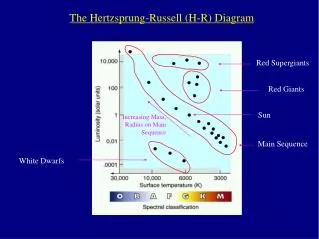
Projects • Evolve from initial model to establishment of H burning shell after core H exhaustion • At minimum do z=0, z=0.1solar, z=solar, z=2solar • for z=2solar use hetoz = 2.0 and 3.0 (see genex) • Note features in the HR diagram and identify with physical processes • Compare results from different metallicity and YHe
What should a star spend most of its time doing? • 1H4He q>10xq for any other stage, lowest threshold T, largest amount of available fuel
The PP Chain • Actually three reaction branches • PPI: p(p,e+,)d d(p,)3He 3He(3He,2p)4He • PPII 3He(4He, )7Be 7Be(e-,)7Li 7Li(p,)4He • PPIII 7Be(p,)8B 8B(e+ decay)24He • PPII/III dominate at high T, high Yhe • Sun predominantly PPII
CNO Cycle CN: 12C(p,)13N 13N(+)13C decays are weak rather than strong rxns - longer 13C(p,)14N timescales, produce bottlenecks 14N(p,)15O 15O(+)15N 15N(p,)12C 15N(p,)16O NO: Higher coulomb barriers - higher T 16O(p,)17F 17F(+)17O 17O(p,)14N OF: 17O(p,)18F 18F(-,)18O 18O(p,)19F 19F(p,)16O
CNO vs. PP Chain • Equate CNO and PP energy production to find where each dominates • T ~ 1.7x10⁷(XH/50XCN)1/12.1 • Crossover point occurs at ~ 1.1 M for Pop I • At z=0 must reach He burning T and produce CNO catalysts • (PP)~X2H0(T/T0)4.6 ; (CNO) ~XHXCNOfN0(T/T0)16.7 • PP and CNO have to produce same luminosity to support a given mass but CNO works over much narrower T range • Energy from CNO deposited in very small radius - too much to carry by radiation • 1st physical division of stellar types: PP dominated with no convective core and CNO dominated with convective core at ~1.1M
Problems of convective cores • Convective core size determines • Luminosity • Entropy of burning • progress of later burning stages & yields • How do we measure core size? • Indirectly • Binaries (esp. double lined eclipsing binaries) give precise masses and radii. If predicted core size too small model is underluminous. Radius also too small since central condensation fluffy exterior • Cluster ages - turnoff ages lower than ages determined by independent means like Li depletion in brown dwarfs • Width of the main sequence - centrally condensed stars evolve further to the red • Directly - apsidal motion of binaries - stars not point masses tidal torques cause line of apsides of orbit to precess. Rate of precession depends on central condensation
Problems of convective cores • Apsidal motion - stars not point masses so tidal torques cause precession of the line of apsides of the orbit • Rate of precession depends on central condensation of star • Stars with larger convective cores more centrally condensed
Problems of convective cores • Mixing length models always predict core sizes too small • Posit “convective overshooting” and say material mixed some arbitrary distance outside core • Various levels of sophistication, but always observationally calibrated • Amount of overshooting needed varies with mass - calibration for one star won’t work for different ones
Convection Bouyant force per unit volume If the signs of fBand r are opposite fB is a restoring force implies harmonic motion of the form where N is the Brünt-Väisälä frequency N2=-Ag N2<0 implies and exponentially growing displacement - unstable N2>0 oscillatory motion - g-mode/internal waves Locally the acceleration is
Convection • Deceleration of plumes occurs in a region formally stable against convection • Region may still be mixed turbulently if energy in shear > potential across region established by stratification • If less, material displaced by plume, not engulfed or continuing to accelerate, and returns to original position - harmonic lagrangian motion • Richardson number characterizes stability of stratification to energy deposited in shear - real criterion for bulk fluid flow • Stars dominated by radiation pressure have less restoring force - effect of waves & boundary stability INCREASES WITH MASS
Convection • Richardson number characterizes stability of stratification to energy deposited in shear - real criterion for bulk fluid flow • Ri<0.25 fully turbulent, shear from plume spreading & nonlinear waves • Ri<1.0 non-linear waves break & mix • Ri>1.0 linear internal waves
Convection • Richardson number characterizes stability of stratification to energy deposited in shear - real criterion for bulk fluid flow • Ri<0.25 fully turbulent, shear from plume spreading & nonlinear waves • Ri<1.0 non-linear waves break & mix • Ri>1.0 linear internal waves
The Convective Boundary • Boundary characterized by Richardson number Ri = N2 / (∂u/∂r)2 : Ratio of potential energy across a layer to energy in shear • Ri ~ 0.25: • Boundary region. Impact of plumes deposits energy through Lagrangian displacement of overlying fluid. Internal waves propagate from impacts. Ri<0.25 turbulent. • Conversion of convective motion to wave motion. Shear instabilities, nonlinear waves mix efficiently, large luminosity carried by waves. Vorticity XH Velocity
The Convective Boundary • Boundary characterized by Richardson number Ri = N2 / (∂u/∂r)2 : Ratio of potential energy across a layer to energy in shear • Ri ~ 0.25: • Boundary region. Impact of plumes deposits energy through Lagrangian displacement of overlying fluid. Internal waves propagate from impacts. Ri<0.25 turbulent. • Conversion of convective motion to wave motion. Shear instabilities, nonlinear waves mix efficiently, large luminosity carried by waves. Vorticity XH Velocity
The Convective Boundary • Ri > 0.25-1: Linear internal wave spectrum. • Internal waves propagate throughout radiative region • Radiative damping of waves generates vorticity (Kelvin’s theorem) • Slow compositional mixing • Energy transport changes gradients; generates an effective opacity Baroclinicgenerationterm Vorticity
The Convective Boundary • Ri > 0.25-1: Linear internal wave spectrum. • Internal waves propagate throughout radiative region • Radiative damping of waves generates vorticity (Kelvin’s theorem) • Slow compositional mixing • Energy transport changes gradients; generates an effective opacity Baroclinicgenerationterm Vorticity
Internal Waves • Ri>1.0 linear internal (g-mode) mode waves Kelvin’s theorem: lagranigian displacement and oscillatory motion is irrotational unless there is damping Dissipation of waves by radiative damping generates vorticity - mechanism for mixing in radiative regions
(Fewer) Problems of convective cores • Cluster ages match Li depletion ages • Width of main sequence reproduced
Rotation • Changes stellar structure in several ways • Centripedal accelerations mean isobars not parallel with equipotential surfaces • star is oblate • star is hotter at poles than equator (cetripedal acceleration counters some gravity so pressure support can be less) • T has non-radial components - meridional circulation which transports angular momentum and material • Turbulent diffusion along isobars + radiative losses during meridional circulation & wave motion transport J - setting up shear gradients and diffusing composition • evaluating stability against shear gradients: back to Richardson # • Coupled strongly with waves since waves transport J • not well modeled • waves probably have more effect on core sizes, rotation better at transporting material through radiative region
Other outstanding issues in stellar observations • Observations & potential solutions • Weird nucleosynthesis on RGB/AGB - Li,N,13C enhancements, s process - waves (+ rotation) • He enhancements in O stars, He,N enhancements in blue supergiants - rotation (+waves) • Blue/red supergiant demographics - waves (+rotation)? • Primary nitrogen production in early massive stars - waves (+rotation) • Young massive stellar populations, I.e. terrible starburst models - waves + rotation • eruptions in very massive stars - waves + radiation hydro (+radiative levitation?) • mass loss leading to Wolf-Rayet demographics rotation + waves
Mass luminosity relations again 23 M 52 M • 104 change in energy generation rate between 1 and 23 M • 1.5 change in energy generation rate between 23 and 52 M 1 M
Understanding the Mass-Luminosity Relation Relation of pressure to luminosity At low masses ~1 HSE requires fg=-fp T doubling M requires doubling T, so L16L LM4 (ignoring changes in radius with mass & degeneracy)
Understanding the Mass-Luminosity Relation Relation of pressure to luminosity At high masses 0 HSE requires fg=-fp T4 doubling M requires doubling P, T21/4T L2L LM tL/M t M-3at low mass and t const at high mass
Opacity sources • Thompson scattering (non-relativistic limit of Klein-Nishina) e = mean molecular weight per free e-, muin AMU for h > 0.1mec2 (T~108 K) must account for compton scattering Dominates for completely ionized material During H burning Yegoes from ~0.72 0.4994: fewer e- per nucleon, so scattering diminished. Opacity drops so convective cores shrink on the main sequence Free-free Bound-free - ionization Bound-bound - level transitions H- - free e- from metal atoms weakly bound to H - important in sun Conduction energy transport by e- collisions - important under degenerate conditions - note the mantle of the sun is mildly degenerate
Mass loss • Steady mass loss (neither of the cases pictured above) usually driven by absorption of photons in bound-bound transitions of metal lines • most transitions in metal atoms, so is metallicity dependent • depends on current surface z, so self enrichment important • depends on rotation - higher temperatures and increased radiative flux increase mass loss at poles - higher and asymmetry • Kinematic luminosity of O star wind integrated over lifetime can be ~1051 erg - comparable to supernovae • Eruptions in sun driven by magnetic reconnection • To be explored later: • eruptions in massive stars (pulsational and supereddington instability) • dust driven and pulsational mass loss in AGB stars • continuum driven winds in Wolf-Rayet stars