Download
1 / 10
100 likes | 255 Views
In today's pre-calculus session, we will cover key concepts related to quadratic functions and their application in modeling real-world scenarios, including free fall motion. We will review homework assignments, go over the recent test, and clarify the transition between standard and vertex forms of quadratic equations. Additionally, we'll explore the formulas for height and vertical velocity in free fall. Students are expected to practice algebraic manipulations and apply these concepts in problem-solving exercises.

E N D
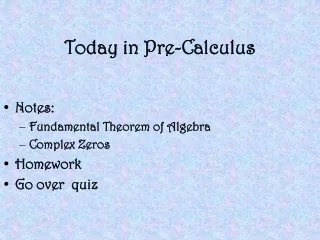
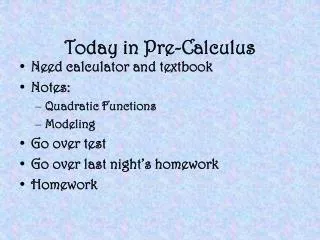
Today in Pre-Calculus • Need calculator and textbook • Notes: • Quadratic Functions • Modeling • Go over test • Go over last night’s homework • Homework
Quadratic Functions Standard form: f(x) = ax2 + bx + c Roots (zeroes or x-intercepts) are found by factoring or using quadratic formula Vertex form: f(x) = a (x – h)2 +k Vertex of the parabola (h, k) Axis of symmetry: x = h
Quadratic Functions To convert from standard form to vertex form using algebra: Complete the square. Example: y = 2x2 + 16x + 31
Practice Example: Use algebra to describe y = 3x2 – 18x – 17 y = 3(x2 – 6x) – 17
Formulas for h and k Example: y = 2x2 + 16x + 31
Example Write the equation for a parabola with a vertex (-1,2) that goes through (6,100).
Vertical Free Fall Motion The height s and vertical velocity v of an object in free fall are given by s(t) = -½ gt2 + v0t + s0 and v(t) = -gt + v0 Where t is time (in seconds), g≈32 ft/sec2 ≈9.8m/sec2 is the acceleration due to gravity, v0 is the initial vertical velocity of the object, and so is its initial height.
Example Page 184: Number 61
Example Number 59
Homework • Pg. 182: 23,25,35,37,39,41,58,62,63