Download
1 / 12
120 likes | 228 Views
Simple machines are devices designed to make work easier by minimizing the input needed to move objects. However, while they reduce effort, the distance an object must move remains unchanged. There are six main types of simple machines: inclined planes, wedges, screws, pulleys, wheels and axles, and levers. Each type functions differently and offers specific mechanical advantages. For example, inclined planes facilitate lifting heavy objects, while levers can change the direction of force exerted. Learning about these machines can enhance efficiency in everyday tasks.

E N D
Simple Machines Devices that “make work easier”
Or do they??? • Work DOES NOT become easier – the object still has to move through the same distance • The amount of input, or effort force, needed to move that object is what becomes easier or less • People use simple machines to lessen the input/effort force they need to apply (which is what we call “work”)
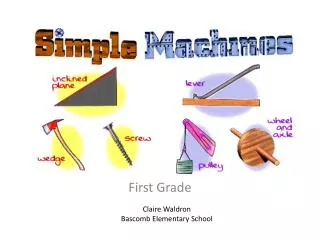
There are technically 6 types… • Inclined Planes • Wedges • Screws • Pulleys • Wheels and Axels • Levers
Inclined Planes • A flat, slanted surface that makes it easier to move heavy objects to higher or lower levels • Connection to station: • Gives mechanical advantage to person by moving large object with less effort; must move it for a longer distance though
Wedges • An inclined plane that is used as a tool for cutting or separating things, or keeping things from moving • Connection to station: • Thicker wedges leave larger cuts but also have more resistance which needs a larger force to create the same cut • Bolt does not have point (wedge)
Screws • An inclined plane wrapped in a spiral around a cylinder or cone • Connection to station: • A right triangle is an inclined plane • A screw is a right triangle around a rod
Pulleys • A wheel with a groove in the rim which a rope fits into • Two types of pulleys: • Fixed – changes the direction of the effort force, but the force must equal the load • Moveable – decreases the effort force needed to move the load, but the rope moves a long distance to move the load a short distance
Pulleys Continued • Connection to station: • Set-up 1 – kind of difficult to lift jug (fixed) • Set-up 2 – easier than first one but more rope needed (movable) • Set-up 3 – easiest of all, but lots more rope needed (combination of fixed and movable) • More pulleys = more rope needed
Wheels and Axles • Wheels rotate in a circle around an axle; axle causes wheels to move • Connection to station: • No S.M. – very difficult to move books • Wheels only – person does most work by having to manually move wheels • Wheels and axles – the axles turn the wheels which decreases the needed effort force
Gears (the 7th S.M.) • Wheels and axles with teeth Click here to understand how gears work
Levers • A straight bar that rests on a fulcrum • Helps you lift heavy loads or change direction of force Click here to help better understand the 3 different classes of levers
Levers Continued • Connection to station: • This was example of 1st class lever (pencil was always between F and L) • Closer the fulcrum is to the load, the less force needed to lift