Download
1 / 27
270 likes | 407 Views
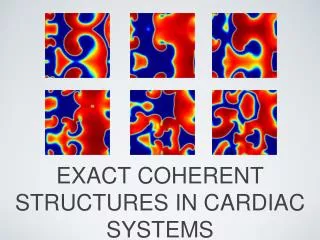
This study investigates the complex dynamics of cardiac systems, emphasizing varying geometries, anisotropy, and the interactions of electrical, fluid, and mechanical dynamics. It reviews both monodomain and bidomain modeling approaches, tackling the understanding of ionic current modeling and its influence on cardiac cell behaviors. We explore operator-splitting methods for computational solutions and outline efficient techniques employing GPU programming for cardiac simulations. This work aims to clarify the dynamics of cardiac systems to develop effective control mechanisms.

E N D
Shen, H. W., & Pang, A. (2007). Anisotropy based seeding for hyperstreamline. Biomedical Physics at MPI for Dynamics and Self-Organization http://www.bmp.ds.mpg.de/imaging-electro-mechanical-waves.html THE HEART • Complicated geometries • orientation, dimensionality, anisotropy, defects • Electrical dynamics • Fluid dynamics • Mechanical dynamics
THE HEART PROBLEM • pulse waves • spiral waves • turbulence Experiment and simulation: F. Fenton, E. Cherry thevirtualheart.org Can we understand these dynamics to control the system?
MONODOMAIN • Effective field equation • Averages over the inside, membrane, and immediate outside of cardiac cells • Easy to analyze • Dynamics are weakly effected by geometry
BIDOMAIN • Solve voltage over membrane, intracellular, and extracellular domains • Anisotropy effects are irreducible • Additional Poisson solve I don't solve bidomain field equations See Alessandro Veneziani at Emory Math
IONIC CURRENT MODELING • Karma (2, 7) • Simitev-Biktashev (3, 14) • Bueno-Orovio–Cherry–Fenton (4, 28) • Beeler-Reuter (8, ??) • Iyer et al (67, ??) F. Fenton & E. Cherry: http://www.scholarpedia.org/article/Models_of_cardiac_cell
IONIC CURRENT MODELING • Different regions of the heart have different properties and yield different qualitative dynamics • No Navier-Stokes equations for cellular action potential • Karma (2, 7) • Simitev-Biktashev (3, 14) • Bueno-Orovio–Cherry–Fenton (4, 28) • Beeler-Reuter (8, ??) • Iyer et al (67, ??)
KARMA MODEL • Convective instability due to alternans • wavelength modulation • Minimal restitution length http://www.ibiblio.org/e-notes/html5/karma.html
BUENO-OROVIO–CHERRY–FENTON • Reproduces qualitative dynamics from more complicated models • Reproduces dynamics from experimental data • Flexible • Simple – three ionic currents http://www.ibiblio.org/e-notes/html5/bcf.html We pay for realism with obfuscation through generality
THE HEART SOLUTION (On the CPU) • Operator-Splitting • Semi-Implicit • Fourier basis, O(exp(-1/Δx)) • periodic, zero-field, or zero-derivative boundary conditions • Strang (ABA), O(Δt²) • Large time-steps • Easy (spatial) derivatives • Clever flipping restricts to odd/even modes, transforms scale well: Nlog(N)
STRANG-SPLITTING • Most convergent operator-splitting method, without an a priori commutator [A, B] • Solve the pieces where they're best solved • Stitch it together
THE HEART SOLUTION (On the GPU) • No operator-splitting • Fully explicit RK4 O(Δt³) • Stencil approximations • Evaluate entire RHS • Smaller stability window • Rotational symmetry O(Δx⁴) But it is fast
THE GPU • Discretization of space into threads • Local terms (nondifferential) are easy • Nonlocal terms (differential) are hard • memory access patterns • register usage • local memory size • Potential efficiency improvements for operator splitting methods NVIDIA CUDA Programming Guide version 3.0 CC-BY-SA-3.0
THE GPU • Segmenting the space breaks synchronization • Some effort to restore it • Compute the nonlinear update and the diffusion separately • Apply them together • Diffusion is computed by finite-difference stencil and stored apart from the state • time-update by Runge-Kutta
COHERENT STRUCTURES • Generic chaotic trajectory visits the vicinity of unstable coherent structures • Build a map of phase space from the invariant structures • Know where the states are to know where to push them
RECURRENCE • The “wait and see" method Integrate the system for a long time and look for large-scale recurrent structures.
… and some time later… These nearly recurrent states serve as initial conditions for GMRES
GMRES • Generalized Minimal Residual • Newton-Krylov (JFNK) • It's Newton, in Krylov • Solve small linear system instead of large nonlinear one • With an initial perturbation • iteratively build a basis • and an approximate Jacobian in that basis • to compute the correction to the initial guess
GMRES • Find unstable structures with Newton-Raphson methods • The Jacobian is huge • N=128 ⇒ 20.25 GByte* • N=512 ⇒ 1 TByte* • Avoid forming the Jacobian explicitly * Assumes optimal structure using Arnoldi method for two-variable system
ARNOLDI ALGORITHM • Builds an orthonormal basis which spans the least contracting subspace • Builds a small, approximate, and useful Jacobian • Relies only on forward-time integration, and some linear algebra
PERIODIC ORBITS • State (u,v) maps back to (u,v) after some time T • Dynamically or time invariant • At least one marginal mode • Jacobian is uninvertible • Other marginal modes? E.T. Shea-Brown, http://www.scholarpedia.org/article/Periodic_orbit
SYMMETRIES • Constraint equations in the GMRES system • translations in x, y • rotations are harder • Windowing suppresses boundary effects • Effective norm
RESULTS • We got two*! • single pulse wave • relative equilibrium • single spiral core • relative equilibrium? *Families of un-/stable solutions
JUST TWO? • Multi-core states present difficulties • Exponentially weak forcing • Local gauge invariance • local effects of global symmetries • this is hard to deal with
WELL NOW WHAT • Symmetry reduction for a single core • Barkley, Biktashev • Co-moving frame • small set of ODE's which describes the dynamics of a single core
PATHS TOWARD PROGRESS • Why periodic orbits? • Multi-core ⇒ multi-phase • quasi-periodic orbits? • n-core ⇒ n-tori? • Try to balance complexity and non-triviality • Cores by reduction • reduced ODE systems with core-core coupling • networked nonlinear oscillators • Is the PDE even reducible to cores? • Vorticity formulation?
STATE OF THE PROGRAM • Phase space topology • ? Dynamical connections • Reduced order model of dynamics • ? Low-dimensional linear maps in Krylov subspaces • Feedback control • ? Local • ? Global • Efficient solvers • Numerical integration • Newton-Krylov iteration • Dominant unstable regular solutions • Traveling waves (relative equilibria) • Periodic solutions • Relative periodic solutions