Download
1 / 6
60 likes | 205 Views
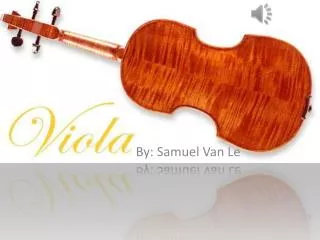
The viola, a member of the string family, is known for its larger size compared to the violin and has served as a vital component in orchestral harmony for centuries. Dating back to the 1500s, its design has remained largely unchanged, evolving from the 'alto-tenor' violin. In modern times, the viola has found its place in various musical genres, including contemporary pop and folk. Electric violas are also available, enabling amplification to enhance sound. Made from materials like spruce and maple, the viola continues to delight musicians and audiences alike.

E N D
Function The function of the viola is to bring entertainment to listeners and to fill in the inner harmonies. This is as difference between a violin(right) and a viola(left) A viola
History(The Least known of the string instruments) • The viola, second member of the strings family, is slightly bigger than the violin. • The viola is a very old instrument. It has been basically unchanged for hundreds of years. • In early orchestral music, the viola part had almost all harmony parts. • Made in 1500s by Gaspara da Salo who was known for cello making. • At first the viola was called the 'alto-tenor' violin, as the term 'viola' was used to refer to any Western classical stringed instrument that was bowed. • 1800-1900 had better parts for the instrument unlike the earlier years. • Now the Viola is in contemporary pop, and folk music. • There are also electric violas now.
Eletric viola • Amplifaction and equalization makes up for the natural sounds a viola can make. • Most eletrical instruments are violin sized, few actuall sized Violas exsits, for people who want the feeling of the actual feeling of a viola. • Some may have internal preamplifier or you can just plug a wire into an amplifier.
Material • Spruce for lightness, flexibility, and strength for sounding boards of instruments. • Maple for being a very hard wood. • The strings are made from a steel core for metal strings, silk, gut(sheep, goat, hog horse, mule, pig, or a donkey) • A winding for a strings are Aluminum, Silver, and chrome steel . • The bow has horse hair, ebony, silk, wire, leather.
Bibliography • "Viola." Wikipedia, the Free Encyclopedia. 24 Oct. 2010. Web. 25 Oct. 2010. <http://en.wikipedia.org/wiki/Viola>. • http://www.stamellstring.com/inventory_violas.html • "Bow (music)." Wikipedia, the Free Encyclopedia. 19 Oct. 2010. Web. 24 Oct. 2010. <http://en.wikipedia.org/wiki/Bow_(music)>. • "General Information about Viola." DOKUZ EYLÜL UNIVERSITY. 24 July 2005. Web. 24 Oct. 2010. <http://www.deu.edu.tr/DEUWeb/English/Icerik/Icerik.php?KOD=3136>. • "Beginning Band: Viola Information." Beginning Band- School Band and Orchestra Information. Web. 25 Oct. 2010. <http://www.beginband.com/viola.shtml>. • Hillard, Kate. "History of the Viola Instrument." Essortment Articles: Free Online Articles on Health, Science, Education & More.. 2002. Web. 25 Oct. 2010. <http://www.essortment.com/all/violainstrument_rfav.htm>.