POPULATIONS
This document explores key concepts in population dynamics, including geographic distribution and population density—high and low density per unit area. It emphasizes growth rates, factors affecting population change such as immigration and emigration, and types of growth: exponential and logistic. The principles of limiting factors, both density-dependent (like competition and predation) and density-independent (such as natural disasters), are discussed to provide insight into how populations interact with their environments and what determines their growth limits.

POPULATIONS
E N D
Presentation Transcript
Leyda POPULATIONS
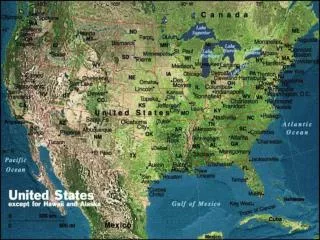
I. DESCRIBING A POPULATION • Geographic distribution: the area inhabited by a population.
I. DESCRIBING A POPULATION 2. Population density: the number of individuals per unit area.
I. DESCRIBING A POPULATION • Population density: the number of individuals per unit area. a. high density: lots of individuals per unit area
I. DESCRIBING A POPULATION • Population density: the number of individuals per unit area. a. high density: lots of individuals per unit area b. low density: few individuals per unit area
I. DESCRIBING A POPULATION • Growth Rate: how quickly a population changes in size. Fast Growth Rate: Slow Growth Rate: 55 Minutes! 55 Years!
II. FACTORS AFFECTING POPULATION GROWTH • ________ rate • ________ rate • birth rate = death rate population size _________________ • birth rate > death rate population size _________________ • birth rate < death rate population size _________________ Birth Death stays the same increases decreases
II. FACTORS AFFECTING POPULATION GROWTH 3. immigration: _________________________________ a. example: ___________________________________________ movement of individuals into an area bison immigrates to a meadow full of grass
II. FACTORS AFFECTING POPULATION GROWTH 4. emigration: _________________________________ a. example: ___________________________________________ movement of individuals out of an area bison emigrates out of a meadow without grass
III. Types of Growth 1. ______________ growth: _________________________________ Individuals reproduce at a constant rate Exponential
III. Types of Growth • ____________ growth: ________________________________ a. Conditions necessary for exponential growth 1. Unlimited resources 2. Absence of disease and predators b. Example: Bacteria will double their population in 20 mins Individuals reproduce at a constant rate Exponential Staphylococcus aureus
III. Types of Growth c. Shape of graph: J-shaped d. Graph example: Notice: as time goes on, population increases exponentially.
III. Types of Growth • ________ growth: ______________________________________ _____________ a. When does population growth slow or stop? 1. Birthrate – Down 2. Immigration – Down 3. Death rate – Up 4. Emigration – Up b. Example: Any animal population in nature. Logistic Population grows rapidly until some factor limits growth
III. Types of Growth c. Shape of graph: S-shaped d. Graph example: Notice: as time goes on, population increases then hits a limit and levels off. This limit is the carrying capacity for that population.
III. Types of Growth e. Carrying capacity: Maximum number of individuals that an area can support.
IV. Limits to Growth Limiting factor: something that causes population growth to decrease. VS
IV. Limits to Growth A. Density-dependent limiting factors: When population is high these take effect. 1. Competition: Organisms compete for food, water, space, sunlight, and other essentials. Example: Birds and mice both eat seeds. Effect on Evolution: Both species are put under pressure to change in ways that decreasecompetition. Remember Competitive Exclusion Principle!
IV. Limits to Growth 2. Predation: One organism eats another. Example: Lynx eats rabbit. Predator: LynxPrey:Rabbit Effect on Evolution: Prey species (rabbit) evolves defenses (speed, camouflage), predators evolve counter-defenses (eyesight).
IV. Limits to Growth Parasitism/disease: Organisms live in and on a host organism. Examples: Ticks, fleas, leeches, tapeworms, bacteria
IV. Limits to Growth B. Density-independent limiting factors: Not related to population size. 1. random events: Unusual weather, natural disasters: volcanoes, hurricanes, floods, ice age
Density-independent limiting factors: Not related to population size. • 2. human disturbances – such as damming rivers and clear-cutting forests.
Density dependent or Independent? • Lava Flow • Number of predators • Spread of disease • Especially cold winter • Toxic chemical spill into a stream • Another species competing for same resource • Diverting river for irrigation • Beetles that attack trees