Ancient China
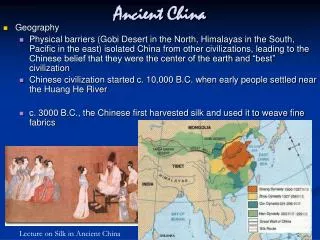
The Huang-He River, often referred to as the "Cradle of Agriculture," has been vital to the development of ancient Chinese civilization due to its rich, fertile lands and the silt it carries, giving it a distinctive yellow color. This river has nurtured societies since the Shang Dynasty (1600-1046 BC), where important advancements like a writing system emerged, allowing for the recording of history. Landmark accomplishments, such as the Great Wall of China, date back to Qin Shi Huang's unification of the country, embodying the Mandate of Heaven, while prosperous times were marked by the Han Dynasty's achievements in governance, invention, and philosophy.

Ancient China
E N D
Presentation Transcript
Huang-He River • “Cradle of Agriculture” • Very fertile • Carries silt from the areas through which it travels- “yellow color”
Shang Dynasty • 1600 BC -1046 BC • Located along the Huang-He river • Important Aspects: Writing System developed • Could record discoveries and history
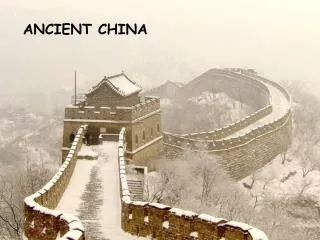
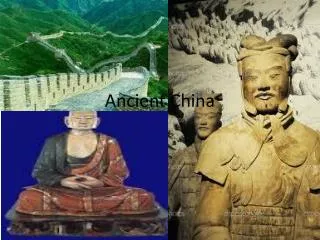
Great Wall of China • Chinese landmark • Built for protection from invasions from the north (Mongols)
Qin Shi Huang 221B.C - 206 B.C • Ruler in China • First emperor • United China into one country
Mandate of Heaven • The belief that gods would only allow a government to stay in power as long as it was good and moral. • Developed during the Zhou Dynasty
Han Dynasty • 206 B.C – 220 A.D • Emperor Wudi (prosperous time for China) • Achievements; • Started a civil service system • Invented paper • Acupuncture
Confucianism • Born 551 BC • Teachings based on honesty • 1st level: being honest is good for your personality • 2nd level: you should be honest out of duty or obligation • 3rd level: you should be honest because you are thinking of the feelings of other people, like your family • Wanted people to think for themselves
Taoism • Chinese Folk Religion • Embraced an ancient Chinese belief in balance • Concept of yin and yang
Silk Road • Trade Route • Traded silk, gold, ivory, exotic animals and other goods • Buddhism spread