Download
1 / 1
10 likes | 106 Views
Cucurbituril Complexes of viologens bound on T I O 2 films for electrochromic materials applications. Elena Galoppini, Department of Chemistry, Rutgers University, Newark NJ.

E N D
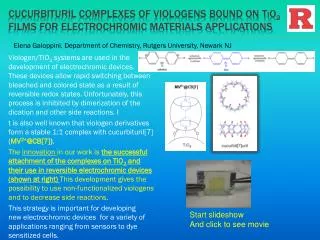
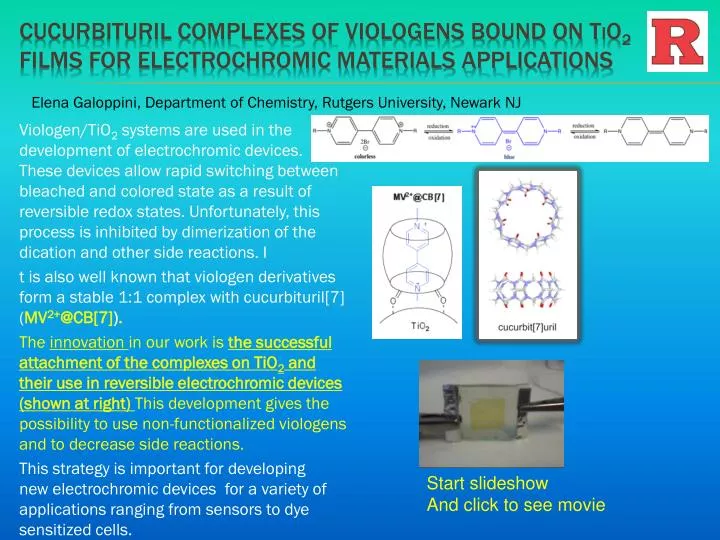
Cucurbituril Complexes of viologens bound on TIO2 films for electrochromic materials applications Elena Galoppini, Department of Chemistry, Rutgers University, Newark NJ Viologen/TiO2 systems are used in the development of electrochromic devices. These devices allow rapid switching between bleached and colored state as a result of reversible redox states. Unfortunately, this process is inhibited by dimerization of the dication and other side reactions. I t is also well known that viologen derivatives form a stable 1:1 complex with cucurbituril[7] (MV2+@CB[7]). The innovation in our work is the successful attachment of the complexes on TiO2 and their use in reversible electrochromic devices (shown at right) This development gives the possibility to use non-functionalized viologens and to decrease side reactions. This strategy is important for developing new electrochromic devices for a variety of applications ranging from sensors to dye sensitized cells. Start slideshow And click to see movie