Download
1 / 18
180 likes | 312 Views
This article explores the classifications of farming, distinguishing between intensive and extensive methods. Intensive farming involves small farms that utilize high inputs of labor and fertilizers, achieving high output per unit of land but low output per worker. In contrast, extensive farming operates on larger farms with minimal inputs, yielding lower production per land unit but higher output per worker. The discussion covers arable, pastoral, and mixed farming, illustrating real-world examples from various countries to clarify their commercial viability and farming characteristics.

E N D
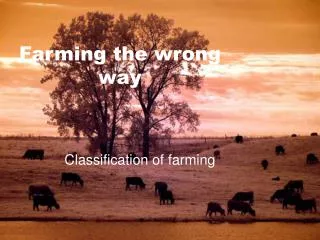
Farming the wrong way Classification of farming
Intensive= small farm + large inputs per unit of land Output per land is high Output per man is low Extensive= large farm + small inputs per unit of land Output per land is low Output per man is high Intensive vs Extensive
Intensive farming • Small farm size • Use a lot of labour + fertilizers • Large production for each unit of land
Extensive farming • Large farm size • Use little labour • Use machines • Small production for each unit of land
Arable farming • Grow crops only • Like rice, wheat
Pastoral farming • Rear animals only (livestock) • Like sheep, cows
Mixed farming • Grow crops + rear livestock
Subsistence farming • Provide food for farmers’ family • Not for sale
Commercial farming • Crops are grown for sale
A wheat farm in the USA • Extensive • Arable • commercial
A sheep farm in New Zealand • Extensive • Pastoral • commercial
A vegetable farm in Hong Kong • Intensive • Arable • commercial
A flower farm in the Netherlands • Extensive • Arable farming • commercial
A vineyard in France • Extensive • Arable • commercial
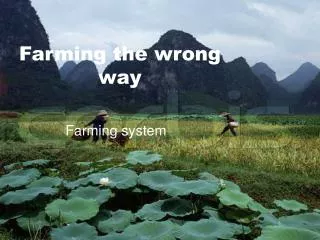
A terraced rice farm in China • Intensive • Arable • subsistence
A wheat-sheep farm in Australia • Extensive • Mixed • commercial
Bye Bye Quack!