Understanding Optics: Key Concepts from PHYSICAL SCIENCE Jeopardy Review
This review explores essential concepts in optics, categorized into topics on photons, reflection, refraction, mirrors, lenses, and their applications. Key questions include the definition of a photon, the laws of reflection and refraction, the significance of optical fibers in communication, and methods of vision correction. The importance of polarization, diffraction, and interference patterns are also discussed, enhancing understanding in the field of optics. This resource is ideal for students preparing for examinations in physics.

Understanding Optics: Key Concepts from PHYSICAL SCIENCE Jeopardy Review
E N D
Presentation Transcript
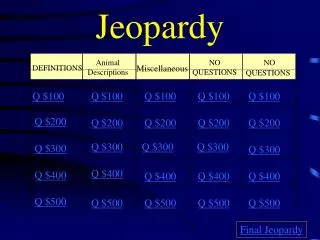
Jeopardy PHY101 Chapter 9 Review Study of Optics Cheryl Dellai
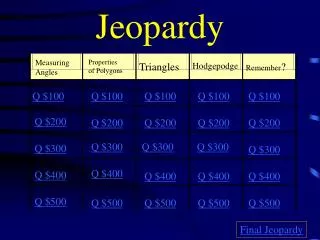
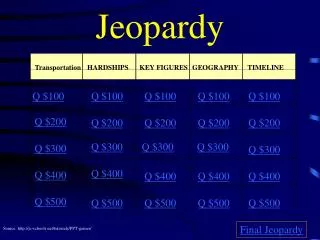
Photons $100 What is a photon? ANSWER
Photons $200 What is the energy of a photon? ANSWER
Photons $300 What can happen to a photon as it moved from one medium to another. ANSWER
Photons $400 What is the index of refraction? ANSWER
Reflection & Refraction $100 State the Law of Reflection. ANSWER
Reflection & Refraction $200 State the Law of Refraction. ANSWER
Reflection & Refraction $300 Why are optical fibers important for communication? ANSWER
Reflection & Refraction$400 Certain types of sunglasses are very effective at diminishing light reflected from surfaces because of __________. ANSWER
Mirrors $100 The direction of light is _____? ANSWER
Mirrors $200 Name 3 types of mirrors ANSWER
Mirrors $300 What is the mirror equation? ANSWER
Mirrors$400 What is the magnification equation? ANSWER
Lenses $100 Choose the lens having the shortest focal length. ANSWER
Lenses $200 What is a Diopter? ANSWER
Lenses $300 What is the thin lens equation? ANSWER
Lenses $400 A person looking through eyeglasses sees ________ & _________ images. ANSWER
Effects $100 Liquid crystal displays make use of __________. ANSWER
Effects $200 Light spreads out when it passes through a narrow slit because of __________. ANSWER
Effects $300 When light passes through two or more narrow slits, an alternating dark and bright pattern is observed on a screen because of _________. ANSWER
Effects $400 The sky is blue because of ________. ANSWER
Potpourri $100 Optical fibers work because of _______. ANSWER
Potpourri $200 You see colors in a rainbow because of _________. ANSWER
Potpourri $300 A ________ lens is used to compensate for hyperopia (farsighted). ANSWER
Potpourri $400 When myopia (nearsighted) is corrected surgically, the shape of the ________ is changed. ANSWER
Photons$100Answer What is a photon? A photon is a wave packet of light. Back to Jeopardy
Photons$200Answer What is the energy of a photon? Energy = hf Planck’s Constant h = 6.63*10-34 J*s Back to Jeopardy
Photons$300Answer • What can happen to a photon as it moved from one medium to another. • Absorbed • Reflected • Refracted Back to Jeopardy
Photons$400Answer • What is the index of refraction? • n = c/v Back to Jeopardy
Reflection & Refraction$100Answer State the Law of Reflection. Angle in = Angle out wrt to the normal normal q q Back to Jeopardy
Reflection & Refraction$200Answer State the Law of Refraction. n1sinq1 = n2sinq2 Back to Jeopardy
Reflection & Refraction$300Answer Why are optical fibers important for communication? They can carry thousands of times the information that wires can. This is the result of internal refraction. Back to Jeopardy
Reflection & Refraction$400Answer Certain types of sunglasses are very effective at diminishing light reflected from surfaces because of polarization. Back to Jeopardy
Mirrors $100Answer The direction of light is positive? Back to Jeopardy
Mirrors $200Answer Name 3 types of mirrors Flat R = infinity Concave R = + Convex R = - Back to Jeopardy
Mirrors $300Answer What is the mirror equation? s-1 + p-1 = 2/R = f-1 s = source p= projection Back to Jeopardy
Mirrors $400Answer What is the magnification equation? s = source p= projection Back to Jeopardy
Lenses $100Answer Choose the lens having the shortest focal length. A The thickest in the middle has the shortest focal length. These are all positive (converging) lenses Back to Jeopardy
Lenses $200Answer What is a Diopter? DO =1/f where f is in meters Back to Jeopardy
Lenses $300Answer What is the thin lens equation? s-1 + p-1 = f-1 =(n2/n1 -1)*(1/R1 – 1/R2) s = source p= projection Back to Jeopardy
Lenses $400Answer A person looking through eyeglasses sees virtual & erect images. Back to Jeopardy
Effects $100Answer Liquid crystal displays make use of polarization. Back to Jeopardy
Effects $200Answer Light spreads out when it passes through a narrow slit because of diffraction . Back to Jeopardy
Effects $300Answer When light passes through two or more narrow slits, an alternating dark and bright pattern is observed on a screen because of interference. Back to Jeopardy
Effects $400Answer The sky is blue because of scattering. Back to Jeopardy
Potpourri $100Answer Optical fibers work because of total internal reflection. Back to Jeopardy
Potpourri $200Answer You see colors in a rainbow because of dispersion. Back to Jeopardy
Potpourri $300Answer A converging lens is used to compensate for hyperopia (farsighted). Back to Jeopardy
Potpourri $400Answer When myopia (nearsighted) is corrected surgically, the shape of the cornea is changed. Back to Jeopardy