Download
1 / 29
300 likes | 456 Views
Delve into the fascinating worlds of the Olmec and Maya civilizations, two of Mesoamerica's most influential cultures. Discover the unique features of each society, from the Olmec's early cities like San Lorenzo, known for their pyramid-like structures and ceremonial mounds, to the Maya's sophisticated writing system and advanced calendar. Learn about their religious practices centered around jaguar gods, trade networks, and governmental hierarchies. Engage with their cultural contributions, including art, ballgames, and leisure activities that shaped their rich legacies.

E N D
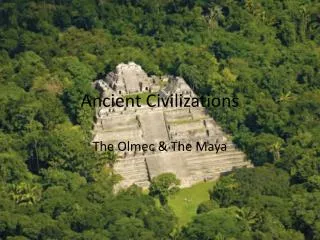
Ancient Civilizations The Olmec & The Maya
What’s Different? Olmec Mayan
Physical Environment • Oldest city—San Lorenzo • Present day Mexico • Located near a river
Architecture • Pyramid like Buildings • First to build 2 story houses • Made houses out of clay • Cities were centered around a grand ceremonial mound
Language • Mixe–Zoquean (spoken) • May have been first to develop writing system • Used symbols
Scientific Knowledge • Writing system • Long count calendar system • Concept of Zero • Ballgame
Leisure Activities • “Mesoamerican Ballgame”
Religious Activities • Religious activities were performed by Shamans • Beliefs centered upon a jaguar God • Bloodletting ceremonies
Governing Structure • Hierchial • Rulers
Economic Activities • Trade Systems
Physical Environment • Present day southern Mexico, Guatemala, northern Belize
Architecture • Stepped pyramids • Plazas • Acropolis • Ball sites • Cave sites • Observatories
Language • Fully Developed written system
Scientific Knowledge • Writing • Hieroglyphs • Counting system • Mathematical
Leisure Activities • Art • Ballgames • Music
Religious Beliefs • Rituals • Ceremonies • Human sacrifice • Maize God • Based on celestial cycles
Governing Structure • Polity—headed by a hereditary ruler
Economic Activity • Trade system
The Mound builders Adena, Hopewell, Mississippian
Physical Environment • From Great Lakes to Gulf of Mexico & the Mississippi to the Appalachian Mountains
Architecture • Built Mounds for religious, ceremonial & burial purposes • Flat-topped pyramids
Language • Petroglyphs • No writing system
Scientific Knowledge • Cultivation of corns, beans & squash • Made tools & weapons
Leisure Activities • Pottery • Wove baskets • Carved canoes • Sewing
Religious Beliefs • Animal spirits • Weather spirits • Ancestor Spirits
Governing Structure • Elite class-ruling class • Common class-Food producers/labor force
Economic Activity • Trade