Understanding Hydrogen Ionization and Energy Transitions in Atomic Levels
This document explores the concept of ionization energy in hydrogen, detailing the energy levels of its electron and the process of energy release during electronic transitions between these levels. It explains why ionized electrons possess zero potential energy due to lack of attraction to the nucleus and discusses the calculated energy differences when an electron moves between various states, alongside the resultant photon emissions. The text provides key calculations, including energy in electron volts, energy in joules, and frequency of emitted light corresponding to transitions from excited states to the ground state.


Understanding Hydrogen Ionization and Energy Transitions in Atomic Levels
E N D
Presentation Transcript
En eV ionisation n = ∞ 0 n = 4 - 0.85 - 1.51 n = 3 - 3.4 n = 2 n = 1 ground state - 13.6 N.B. All energies are NEGATIVE. REASON: The maximum energy is the energy to ionise the electron. However an ionised electron feels no attraction to the nucleus so it must have zero potential energy. It follows that energies less than the ionisation energy must be negative e-
En eV ionisation n = ∞ 0 n = 4 - 0.85 - 1.51 n = 3 - 3.4 n = 2 n = 1 ground state - 13.6 If a hydrogen atom has its electron in the lowest energy level (ie -13.6eV) it is said to be in the ground state. If an electron absorbs energy and moves to a higher energy level (ie an excited state) it will be unstable and quickly fall back to the ground state, releasing energy as a photon as it falls. Sometimes the energy of these photons correspond to the energy of visible light. e-
En eV ionisation n = ∞ 0 n = 4 - 0.85 - 1.51 n = 3 - 3.4 n = 2 n = 1 ground state - 13.6 Determine the amount of energy that would be released when an electron falls from energy level: n=4 -> n=2 n=3 -> n=2 n=3 -> n=1 n=2 -> n=1 n=4 -> n=1
En eV ionisation n = ∞ 0 n = 4 - 0.85 - 1.51 n = 3 - 3.4 n = 2 n = 1 ground state - 13.6 e- Determine the amount of energy that would be released when an electron falls from energy level: n=4 -> n=2 (ie 3.4-0.85 = 2.55eV (ie 4.08x10⁻¹⁹J)) n=3 -> n=2 n=3 -> n=1 n=2 -> n=1 n=4 -> n=1
En eV ionisation n = ∞ 0 n = 4 - 0.85 - 1.51 n = 3 - 3.4 n = 2 n = 1 ground state - 13.6 e- Determine the amount of energy that would be released when an electron falls from energy level: n=4 -> n=2 (ie 3.4-0.85 = 2.55eV (ie 4.08x10⁻¹⁹J)) n=3 -> n=2 (ie 3.4-1.51= 1.89eV (ie 3.024x10⁻¹⁹J)) n=3 -> n=1 n=2 -> n=1 n=4 -> n=1
En eV ionisation n = ∞ 0 n = 4 - 0.85 - 1.51 n = 3 - 3.4 n = 2 n = 1 ground state - 13.6 e- Determine the amount of energy that would be released when an electron falls from energy level: n=4 -> n=2 (ie 3.4-0.85 = 2.55eV (ie 4.08x10⁻¹⁹J)) n=3 -> n=2 (ie 3.4-1.51= 1.89eV (ie 3.024x10⁻¹⁹J)) n=3 -> n=1 (ie 13.6-1.51= 12.09eV (ie 1.93x10⁻¹⁸J)) n=2 -> n=1 n=4 -> n=1
En eV ionisation n = ∞ 0 n = 4 - 0.85 - 1.51 n = 3 - 3.4 n = 2 n = 1 ground state - 13.6 e- Determine the amount of energy that would be released when an electron falls from energy level: n=4 -> n=2 (ie 3.4-0.85 = 2.55eV (ie 4.08x10⁻¹⁹J)) n=3 -> n=2 (ie 3.4-1.51= 1.89eV (ie 3.024x10⁻¹⁹J)) n=3 -> n=1 (ie 13.6-1.51= 12.09eV (ie 1.93x10⁻¹⁸J)) n=2 -> n=1 (ie 13.6-3.4= 10.2eV (ie 1.63x10⁻¹⁸J)) n=4 -> n=1
En eV ionisation n = ∞ 0 n = 4 - 0.85 - 1.51 n = 3 - 3.4 n = 2 n = 1 ground state - 13.6 e- Determine the amount of energy that would be released when an electron falls from energy level: n=4 -> n=2 (ie 3.4-0.85 = 2.55eV (ie 4.08x10⁻¹⁹J)) n=3 -> n=2 (ie 3.4-1.51= 1.89eV (ie 3.024x10⁻¹⁹J)) n=3 -> n=1 (ie 13.6-1.51= 12.09eV (ie 1.93x10⁻¹⁸J)) n=2 -> n=1 (ie 13.6-3.4= 10.2eV (ie 1.63x10⁻¹⁸J)) n=4 -> n=1 (ie 13.6-0.85= 12.75eV (ie 2.04x10⁻¹⁸J))
n = ∞ 0 n = 4 - 0.85 - 1.51 n = 3 - 3.4 n = 2 Spectrum λ En eV ionisation e- e- e- e- - 13.6 n = 1 ground state BALMER series VISIBLE
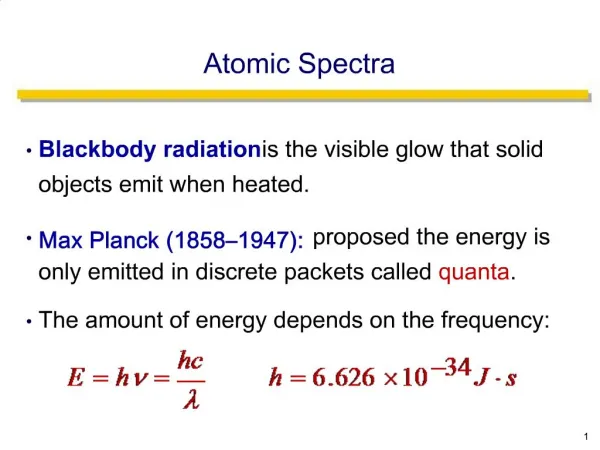
En eV ionisation n = ∞ 0 n = 4 - 0.85 - 1.51 n = 3 - 3.4 n = 2 n = 1 ground state - 13.6 e- e- The energy difference between levels n=4 & n=2 is 2.55eV ie 4.08x10⁻¹⁹J, and between energy levels n=3 & n=2 is 1.89eV ie 3.024x10⁻¹⁹J. These energy drops correspond to the red and green lines in the hydrogen spectrum. The frequency of these lines can be determined by E = hf
En eV ionisation n = ∞ 0 n = 4 - 0.85 - 1.51 n = 3 - 3.4 n = 2 n = 1 ground state - 13.6 e- e- 4.08x10⁻¹⁹J 3.024x10⁻¹⁹J Use E = hf, and the values of the energy differences between levels to determine the frequencies of the light emitted.
En eV ionisation n = ∞ 0 n = 4 - 0.85 - 1.51 n = 3 - 3.4 n = 2 n = 1 ground state - 13.6 e- e- 4.08x10⁻¹⁹J 3.024x10⁻¹⁹J E = hf f =E/h f =4.08x10⁻¹⁹/6.63x10-34 f = 6.15x10¹⁴Hz E = 4.08x10⁻¹⁹J h = 6.63 x 10⁻³⁴Js f = ?
En eV ionisation n = ∞ 0 n = 4 - 0.85 - 1.51 n = 3 - 3.4 n = 2 n = 1 ground state - 13.6 e- e- 4.08x10⁻¹⁹J 3.024x10⁻¹⁹J E = hf f =E/h f =3.024x10⁻¹⁹/6.63x10-34 f = 4.56x10¹⁴Hz E = 3.024x10⁻¹⁹J h = 6.63 x 10⁻³⁴Js f = ?
En eV ionisation n = ∞ 0 n = 4 - 0.85 - 1.51 n = 3 - 3.4 n = 2 n = 1 ground state - 13.6 e- e- 4.08x10⁻¹⁹J 3.024x10⁻¹⁹J Calculate the wavelength of these radiations. c = f x E = 3.024x10⁻¹⁹J h = 6.63 x 10⁻³⁴Js F3-2 = 4.56x10¹⁴Hz E = 4.08x10⁻¹⁹J h = 6.63 x 10⁻³⁴Js F4-2 = 6.15x10¹⁴Hz
En eV ionisation n = ∞ 0 n = 4 - 0.85 - 1.51 n = 3 - 3.4 n = 2 n = 1 ground state - 13.6 e- e- 4.08x10⁻¹⁹J 3.024x10⁻¹⁹J • Calculate the wavelength of these radiations. • c = f x • 3x108=4.56x10¹⁴x • = 6.57x10⁻⁷m and • 3x108=6.15x10¹⁴x • = 4.88x10⁻⁷m E = 3.024x10⁻¹⁹J h = 6.63 x 10⁻³⁴Js F3-2 = 4.56x10¹⁴Hz E = 4.08x10⁻¹⁹J h = 6.63 x 10⁻³⁴Js F4-2 = 6.15x10¹⁴Hz