Prenatal Development
Prenatal development is a complex process that begins with conception, when an egg and sperm unite to form a zygote with 23 pairs of chromosomes. This journey includes three primary stages: the zygote stage (weeks 1-2), the embryonic stage (weeks 3-8), and the fetal stage (weeks 9-38). Each stage involves critical milestones, including cell differentiation, organ development, and neural growth, culminating in the formation of all major body structures and systems. Understanding these stages enhances our comprehension of human development and the importance of early life environments.

Prenatal Development
E N D
Presentation Transcript
Prenatal Development • We have the gametes, eggs and sperm, produced by meiosis and each with half of the required genetic material (a single set of 23 chromosomes) • conception - egg and sperm come together to produce a single cell or zygote that has all of the genetic material (23 pairs of chromosomes) and development begins
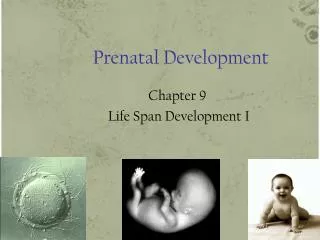
Stage 1: Zygote (Conception - 2 weeks) • Cells multiply by mitosis • Changes to hollow ball of cells, called a blastoma • Implants in uterus • Cells begin to differentiate and specialize into the cells that will be the embryo and those that will support the embryo (e.g. amniotic sac, umbilical cord)
Stage 2: Embryo (3 - 8 weeks) • All major internal and external structures form • Three layers of cells • Endodermal - internal organs • Ectodermal - nervous system, eyes, ears, skin • Mesodermal - muscles, bones, heart • Major brain development in week 5
Stage 2 (Cont.) • Head is 50% of mass
Stage 3: Fetus (9 - 38 weeks) • Further development of body so at birth head is only 25% of mass
Stage 3 (Cont.) • By 3 months, brain has differentiated into visual, auditory, and cognitive centers • All of the brain cells of the adult are there by 3 months, but connections among is not • In month 3, physical activity begins with fist forming and toe wiggling
Stage 3 (Cont.) • In month 4, eyes become sensitive to light • In month 5, sounds result in activity, including kicking and turning • Also may begin to show a sleep/activity cycle
Stage 3 (Cont.) • Later development includes progress in the brain, lungs, development of fat that allows at least some breathing, temp regulation • greater viability if premature • In month 8, immune system starts to pick up with help from mom
Neural Development • By the end of infancy the volume of neurons has increased significantly
Neural Development • The density, however, has decreased
Neural Development • The number of synapses, the synaptic density, and the number of synapse per neuron continue to increase during the first year and then steadily decline
Neural Development • The number of synapses, the synaptic density, and the number of synapse per neuron continue to increase during the first year and then steadily decline
Neural Development • Stages: • Cell Production - Fetus • Cell Migration - 7 mos. • Cell Elaboration • Culling • Myelination - 4 yrs.
Brain Development • Brain becomes more hemispherically specialized • Different brain areas for different functions • Frontal • Parietal • Occipital • Temporal • Cerebellum
Brain Areas • Brain Stem: • Role in basic attention, arousal, and consciousness. All information to and from our body passes through the brain stem on the way to or from the brain.
Brain Areas • Cerebellum: • Involved in the coordination of voluntary motor movement, balance and equilibrium and muscle tone. • Possibly involved in working memory.
Brain Areas • Occipital Lobe: • The center of our visual perception
Brain Areas • Temporal Lobe: • Involved in the primary organization of sensory input. • Language is also a function, especially in terms of verbal labels for sensory information. • The temporal lobes are highly associated with memory skills.
Brain Areas • Parietal Lobe: • Can be divided into two functional regions. • The first function integrates sensory information to form a single perception (cognition). • The second function constructs a spatial coordinate system to represent the world around us.
Brain Areas • Frontal Lobe: • Involved in higher-order cognitive abilities • Reasoning and decision making • Also responsible for planning • Pre-frontal area involved in working memory and decision making
Brain Development • In terms of differentiation of the different areas of the brain, this occurs in the fetus. • Also, early in the fetus, the brain is fairly smooth, but by the time the infant is born much of the convolutions and invaginations have occurred
Brain Development • After birth, myelination begins and continues for many years • Myelination allows speedy transmission of signals across neurons and between neurons • Further development of the different brain areas continue in an inside-out fashion (subcortical --> cortical)
Brain Development • The subcortical to cortical development of the control of behavior has been best demonstrated via visual behavior • Johnson (1990) suggest that newborns visual behavior, particularly their eye movements, are controlled by subcortical pathways • During the first 6 months, the cortical pathways functionally develop so that they can influence eye movements
Johnson (1990) • One particular hypothesis concerned anticipatory eye movements • Required the functioning of mechanisms within the frontal cortex • Therefore, should not see anticipatory eye movements before approximately 20 weeks of age • Recent results by Haith, Hazan & Goodman (1988), Canfield & Smith (1996), and Adler & Haith (in press) indicate that infants as young as 12 weeks exhibit anticipatory eye movements • Indicates that frontal cortex is functional earlier than believed