Download
1 / 33
350 likes | 518 Views
This document explores the implementation of the Technological Pedagogical Content Knowledge (TPACK) model in Dutch for Academic Purposes courses. It highlights teaching methodologies aimed at improving student engagement and active participation. Key findings include the effectiveness of varied learning activities, peer feedback, and the use of technology to foster independent learning. Recommendations emphasize personal learning objectives and the thoughtful integration of technology to support teaching goals. This framework aims to enhance the overall learning experience for bachelor and premaster students.

E N D
Teaching with TPACK Janneke van der Loo Tilburg School of Humanities
Dutch for Academic Purposes • 250 bachelor & premaster students CIW • Methodology • 2 ects • 2 papers 1.4 teacher… • 40 bachelor students ACW/RSC/FIL • Philosophy of Science • 5 ects • 2 papers
Dutch for Academic Purposes CIW My goals • Variation in teaching & learning activities • Active participation students • Effective feedback for students
“There is no single technological solution that applies for every teacher, every course, or every view of teaching.” Mishra & Koehler, 2006
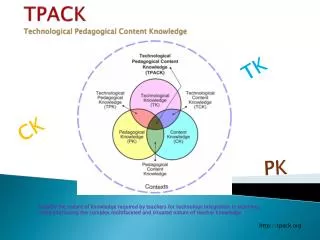
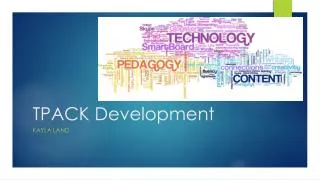
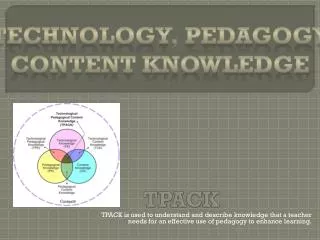
Technological Pedagogical Content Knowledge Model by Mishra & Koehler (2006) http://tpack.org
Mishra & Koehler (2006) http://tpack.org
Activitieswith technology
E-voting Activate students in lectures Language test
Kies het juiste werkwoord.Uitonderzoekblijktdat 50% van de studentengemiddeld 3 keer per week van profielfoto ______. • veranderen • veranderden • verandert • veranderd
My findings + Change of activity during a lecture > more attention, fun! + Clear expectations language test
Weblectures Knowledge transfer Components academic paper
http://videocollege.uvt.nl/mediasite/Viewer/?peid=d8453546993c48eba7c15388746954241dhttp://videocollege.uvt.nl/mediasite/Viewer/?peid=d8453546993c48eba7c15388746954241d
My findings + Time, place and pace independent + Efficient use of contact hours (the “flipped” classroom)
Wiki Collaborative learning Responsibility own learning Criteria academic paper
My findings + Students can come up with their own criteria > more ‘acceptance’ on assessment + Students have to think explicitly on what is a good paper > more retention − Individual work on a collaborative assignment
GradePeer Specifics of paper dealing with corpus analysis Peer feedback
My findings + Time, place and pace independent + Very user friendly system + Individual feedback for students + By grading another student, students get more insight in their own answers. − Limited options in the system http://uvtapp.uvt.nl/fsw/spits.gradepeer_lib.frmindex
Screencast program Reflection Writing strategies
The assignment What? Write a position paper Why? Insight writing strategies How? Think Aloud Protocol With..? www.screencastomatic.com / microphone
My findings + Time and place independent + Efficient use of contact hours + Confrontation with personal strategies on video! − Some students were hesitant to speak to the computer.
The assignment What? Write a position paper Why? Insight writing strategies How? Think Aloud Protocol With..? An observant (and screencastomatic if you have a laptop!)
My findings + Nice buzz in the classroom + Teacher present to stimulate hesitant students + Immediate discussion on strategies • Some students found it hard to concentrate • Observant became ‘partner’
Peer feedback • Easy to organize • Convenient for planning • Teacher present for questions Set-up mini-tutorial • Form pairs • Formulate feedback, based on checklist (25 min) • Discuss feedback student A (5 min) • Discuss feedback student B (5 min) • General tips & conclusions (10 min)
Peer feedback My findings + Easy to organize + Convenient for planning + Teacher present for questions Set-up mini-tutorial • Form pairs • Formulate feedback, based on checklist (25 min) • Discuss feedback student A (5 min) • Discuss feedback student B (5 min) • General tips & conclusions (10 min)
TPACK – the game • Make a list of possible technologies and discuss a realistic example of an activity you could use in your teaching. • Technology:…………..? • Pedagogy: discussion • Content: media literacy (“mediawijsheid”)
My advice? Use TPACK • to find out about which elements of the model you already know a lot, and on which elements you can still improve; • to set personal learning objectives and to make conscious decisions on the integration of technology in your teaching.
Questions? Interesting links: • www.21edingen.nl • http://web2-0eduapp.wikispaces.com/ • http://tpack.org