Download
1 / 2
20 likes | 159 Views
This assignment involves writing a MATLAB program to generate forward and inverse N-point number theoretic transform (NTT) matrices for a given modulus M. The program must output two N×N matrices, A (forward) and B (inverse), while ensuring it runs efficiently for large values of N. Additionally, the assignment includes questions on the complexities and advantages of various transforms, including the Walsh transform and its comparison with the DFT, as well as the effects of CDMA modulation.

E N D
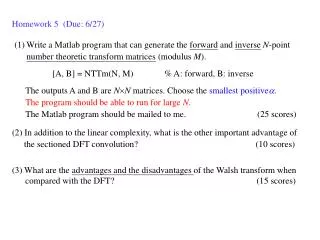
Homework 5 (Due: 6/27) • Write a Matlab program that can generate the forward and inverseN-point number theoretic transform matrices (modulus M). • [A, B] = NTTm(N, M) % A: forward, B: inverse • The outputs A and B are NN matrices. Choose the smallest positive. • The program should be able to run for large N. • The Matlab program should be mailed to me. (25 scores) (2) In addition to the linear complexity, what is the other important advantage of the sectioned DFT convolution? (10 scores) (3) What are the advantages and the disadvantages of the Walsh transform when compared with the DFT? (15 scores)
(4) Suppose that X[m] and Y[m] are the 16-point Walsh transforms of x[n] andy[n], respectively, and z[n] is the 16-point inverse Walsh transform ofX[m]Y[m]. Determine kn such that (10 scores) (5) Why the NTT does not require any addition and multiplication operation especially when M (the adopted prime number) is small? (10 scores) (6) Why the orthogonal transform plays a very important role in signal processing? (10 scores) (7) (a) What is the results of CDMA if there are three data [1 0 1], [1 1 0], [0 0 1]and these three data are modulated by the 1st, 4th, and 10thcolumns (equivalent to the 1st, 4th, and 10throws) of the 16-point Walsh transform? (b) Is it better to use the NTT for CDMA? Why? (20 scores)