Standing Plasmon Waves on Silver Grating Structures: Experimental and Numerical Insights
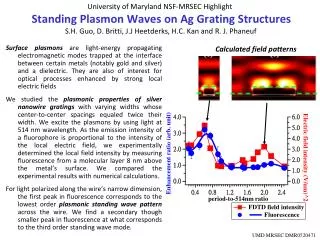
This study examines the plasmonic properties of silver nanowire gratings with varying widths. Surface plasmons are electromagnetic modes that propagate at the metal-dielectric interface, crucial for enhancing optical processes through strong local electric fields. By exciting plasmon resonances using 514 nm wavelength light, we measured local field intensity via fluorescence from a molecular layer above the metal surface. Our findings reveal distinct peaks in fluorescence corresponding to the lowest and third order plasmonic standing wave patterns, integrating experimental data with numerical simulations.

Standing Plasmon Waves on Silver Grating Structures: Experimental and Numerical Insights
E N D
Presentation Transcript
University of Maryland NSF-MRSEC Highlight Standing Plasmon Waves on Ag Grating Structures S.H. Guo, D. Britti, J.J Heetderks, H.C. Kan and R. J. Phaneuf Calculated field patterns Surface plasmons are light-energy propagating electromagnetic modes trapped at the interface between certain metals (notably gold and silver) and a dielectric. They are also of interest for optical processes enhanced by strong local electric fields We studied the plasmonic properties of silver nanowiregratings with varying widths whose center-to-center spacings equaled twice their width. We excite the plasmons by using light at 514 nm wavelength. As the emission intensity of a fluorophore is proportional to the intensity of the local electric field, we experimentally determined the local field intensity by measuring fluorescence from a molecular layer 8 nm above the metal’s surface. We compared the experimental results with numerical calculations. For light polarized along the wire’s narrow dimension, the first peak in fluorescence corresponds to the lowest order plasmonic standing wave pattern across the wire. We find a secondary though smaller peak in fluorescence at what corresponds to the third order standing wave mode. UMD MRSEC DMR0520471