Magnification, Resolution and Illumination
180 likes | 686 Views
Magnification, Resolution and Illumination. Cell Biology: Magnification and Illumination. Let's take a look at the secret life inside our cells. How large are cells?. Let's put things into perspective. Size is relative…. Is magnification all that matters?Magnification versus Resolution.


Magnification, Resolution and Illumination
E N D
Presentation Transcript
Cell Biology: Magnification and Illumination • Let's take a look at the secret life inside our cells...
How large are cells? Let's put things into perspective....
Is magnification all that matters?Magnification versus Resolution • Is there a limit to magnification? • Does magnification improve resolution? • Resolution of a microscope is its ability to separate small objects which are cose together • Resolution is determined by light/(electron) wavelength; the shorter the wavelength, the higher the resolution • Light microscope resolution is 0.2 μm • Electron microscope resolution is 1 ηm • Scanning Tunnel microscope resolution is 0.01 ηm length 0.01 ηm depth
Light microscope: Magnification Normal maximum magnifications of ocular and objective lenses are 10X and 100X respectively, giving overall maximal magnification of X 1000
Modern Illumination techniques used in light microscopy These techniques modify the light path to generate improved contrast: • Phase contrast micrcoscopy • Cross-polarised (confocal) light microscopy • Dark field microscopy • Fluorescent microscopy
Phase contrast microscopy • Improved contrast, allowing identification of structures in living cells • Allowed us to understand cell division • Won its inventor, Franz Zernike, the NOBEL PRIZE in 1951 • Nobel Prize link to Phase microscope: • Phase Nobel
Contrast Microscopy • Fluorescence contrast techniques • Immunofluorescence techniques • Here is a whole gallery of beautiful images: • Fluorescence Gallery • Cell fluorescence
Electron Microscopy! • Follows the same principles as light microscopy, but shines a beam of electrons rather than light particles • The lower ‘wavelength’ of the electron beam allows incredible resolution • Can visualise particles to the order of a few angstom (10-10m)
Transmission Electron Microscopy • Wellcome scanning microscope • Designed by Ernst Ruska (Heidelberg) in 1938 • He won the Nobel Prize just before his death, in 1986 • First electron microscope was built in Toronto in 1938
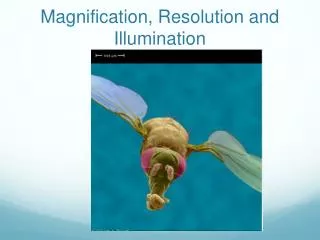
Scanning Electron Microscope • Scanning Electron microscope
Scanning Tunneling Microscope • Sharing a Nobel Prize • Scanning tunneling microscopes