Electronegativity
Electronegativity is the ability of an atom to attract electrons in a covalent bond, influenced by atomic number and the distance of valence electrons from the nucleus. It cannot be directly measured and is often calculated using bond energy changes. Commonly reported in Pauling units, the scale ranges from 0.7 to 3.98, indicating varying attraction levels. Electronegativity typically increases across a period and decreases down a group on the periodic table due to changes in nuclear charge and electron distance. Key factors include noble gases, lanthanides, actinides, and d-block properties.


Electronegativity
E N D
Presentation Transcript
Electronegativity James Lauer, Matt Rose, Tom Greenwood, Eric Gu
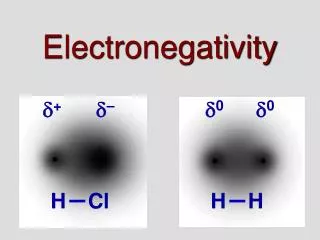
The ability to pull electrons in a covalent bond towards the nucleus of an atom • Affected by atomic number and the distance valence electrons are from the nucleus
Cannot be directly measured and must be calculated from other sources, mostly through measuring how the energy of a bond changes when an atom is added. • Xa - Xb = {[Ed(AB) - 1/2[Ed(AA) + Ed(BB)]}^1/2 • Most commonly measured in Pauling units • Pauling scale runs from 0.7 to 3.98, with smaller quantities experiencing less attraction and larger quantities experiencing greater attraction
Electronegativity generally increases from left groups to right groups and it decreases when going down the periods of the periodic table.
Increases from left groups to right groups because of the increase in the nucleus charge. • This means the atom will have an increased attraction for its outermost electrons.
Decreases from the top period to the bottom period because of they have more valence shells and electrons are further away from the nucleus.
Noble gases, Lanthanides, and Actinides have a complete valence shell so they tend to not attract electrons. • Transition metals’ properties affect their ability to attract electrons as easily as the other elements thus is little variance among them.
Gallium and Germanium have higher electronegativity than Aluminum and Silicon which are above them. This is because of the D-Block Contraction. • D-Block: The D electrons are not good at shielding the nuclear charge, so the atomic radius does not change much as electrons are added. Almost like disregarding the D electrons being added.
Sources http://www.chemguide.co.uk/atoms/bonding/electroneg.html http://hyperphysics.phy-astr.gsu.edu/hbase/chemical/bondd.html