Understanding Electronegativity: Trends, Exceptions, and Key Concepts
This guide explores the concept of electronegativity, defining it as the ability of an atom to attract electrons in a molecule. It outlines key trends, such as how electronegativity decreases down a group due to increased atomic size and shielding effects, while it increases across a period as the nucleus gains protons. Notable examples include fluorine (highest electronegativity) and francium (lowest). Additionally, it discusses exceptions in transition metals and the behavior of noble gases, highlighting their unique position in electronegativity discussions.

Understanding Electronegativity: Trends, Exceptions, and Key Concepts
E N D
Presentation Transcript
Electronegativity, Yo! Niquisha, RayDizzle, Ashwayze
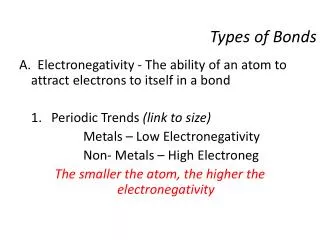
Definition: • A measure of the ability of an atom in a molecule to attract electrons to itself.
Trends: • Electronegativity decreases down a column. • The inner core electrons shield the positive charge of the nucleus from the outer electrons. • So as the orbital size increases, it is more difficult for the protons of the atom to attract electrons.
Trends: • Electronegativity increases across a row from left to right. • As you move across a period, the nucleus gains protons and is therefore more attractive to electrons. • http://en.wikipedia.org/wiki/Electronegativity
Highest • Fluorine • Needs one more electron, so has a higher tendency to form a negative ion.
Lowest • Francium • Easier to lose an electron than gain seven to become stable .
Units: • Nope.
Exceptions (Down a Column): • Generally, the shielding effect of the d group isn’t as strong because the new electrons are put INSIDE, not added to the outer oribital. This means that as the atomic number increases, the atomic radius doesn’t. • Instead of decreasing down a column, most of the transition metal electronegativity values increase.
Exceptions (Across a Period): • In the transition metals, some elements do not follow the trend of increasing from left to right. • Mo = 2.2, but Tc = 1.9.
Exceptions: • Noble Gases…duh. • They’re already stable and have full orbitals. Their tendency to attract electrons is minimal to nonexistent.