Download
1 / 18
180 likes | 303 Views
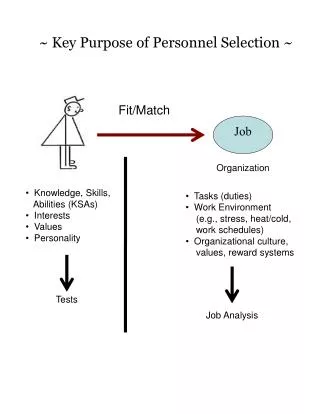
Personnel selection is a critical process that involves gathering and assessing information about job candidates to make informed hiring decisions. Environmental factors, including legal considerations and organizational policies, shape this process. Various selection methods, such as interviews and testing, each have their advantages and disadvantages in terms of reliability and validity. By understanding different interview types and the importance of employment testing, organizations can increase the effectiveness of their selection process while minimizing bias and ensuring compliance with legal standards.

E N D
Personnel Selection The process of gathering & assessing information about job candidates & ultimately making personnel decisions
Environmental Factors • Legal considerations • Time constraints • Organizational hierarchy • Hiring policies • Applicant pool • Type of organization • Other HR functions
Selection Methods: Characteristics • Reliability • Validity • Criterion-related • Content • Construct • Utility • Standardization • Objectivity
Advantages Amount of information Framework Verifiable Disadvantages Prone to subjective screening decisions Tailored to job description EEO violations Initial Screening: Job Application
The Employment Interview The most common personnel selection tool: a goal-oriented exchange of information between an applicant and interviewer(s)
Types of Interviews • Unstructured (Nondirective) • Structured (Directive/Patterned) • Behavioral • Situational • Group/Panel • Hierarchical
Interviews: Potential Problems • Inappropriate questions/topics • Stereotyping bias • Premature judgments • Interviewer’s personal values • Insufficient job knowledge/preview • Deliberate stress • Environment • Interviewer domination • Lack of training
Increasing Validity in the Interview • Understand & use specific job information to form questions • Standardize the physical environment • Weight responses & observations • Use more than one interviewer • Train interviewers & practice with feedback
Employment Testing: Types • Cognitive ability • Job-knowledge & work-sample • Personality
Cognitive Ability Tests • Aptitude, general reasoning ability, memory, vocabulary, verbal fluency, numerical ability • Predict future performance • Wechsler Adult Intelligence Scale (WAIS) • Wonderlic Personnel Test
Cognitive Ability Tests: Problems • Racial differences • Legal precedent • Griggs v. Duke Power • Validity & adverse impact • Uniform Guidelines in Employee Selection Procedures • Basis for employment decisions
Specific Ability Tests • Cognitive abilities, verbal comprehension, numerical reasoning, verbal fluency, mechanical/clerical abilities, physical/psychomotor abilities • Formal • Bennett Mechanical Comprehension Test (BMCT) • Minnesota Clerical Test (MCT) • Informal
Personality An individual’s consistent pattern of behavior composed of psychological traits
Personality Testing • Ability & motivation • Informal v. formal assessment • Projective • Rorschach Inkblot • Graphology • Self-report inventories • Miner Sentence Completion Scale (MSCS) • Minnesota Multiphasic Personality Inventory (MMPI)
The “Big Five” Personality Factors • Extroversion/introversion • Emotional stability/neuroticism • Agreeableness/disagreeableness • Conscientiousness/lack of conscientiousness • Openness/closure to experience
Personality Testing: Problems • Erroneous results • Poorly designed research • Validity studies • Behavior is situational • Widely used • Legal precedent • Saroka v. Dayton Hudson
Pre-Employment Screening • Reference checks • Negligent referral • Negligent hiring • Background investigations • Reasonable investigation • Criminal, credit, worker’s comp history • Medical examination • Drug testing
The Job Offer • Final selection decision • Notification of candidates • In writing • Facts of the offer • Salary • Status • Probationary period • Schedule of benefits