
Comprehensive Guide to LC Detection Systems for Analytical Instruments
E N D
Presentation Transcript
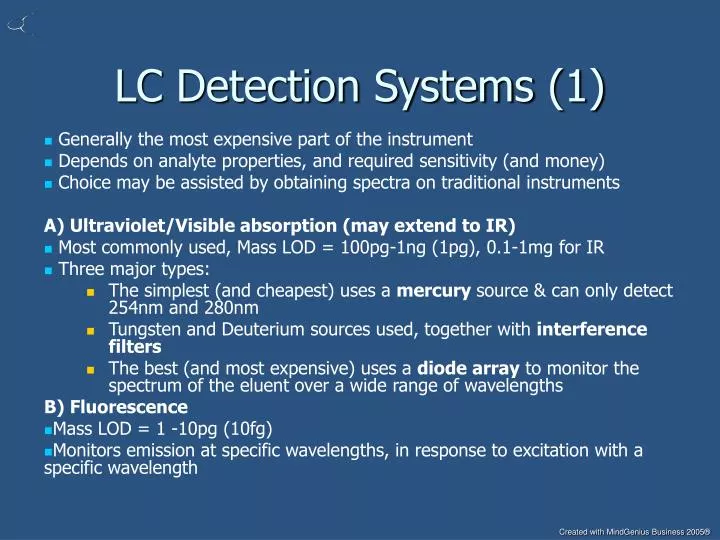
LC Detection Systems (1) • Generally the most expensive part of the instrument • Depends on analyte properties, and required sensitivity (and money) • Choice may be assisted by obtaining spectra on traditional instruments A) Ultraviolet/Visible absorption (may extend to IR) • Most commonly used, Mass LOD = 100pg-1ng (1pg), 0.1-1mg for IR • Three major types: • The simplest (and cheapest) uses a mercury source & can only detect 254nm and 280nm • Tungsten and Deuterium sources used, together with interference filters • The best (and most expensive) uses a diode array to monitor the spectrum of the eluent over a wide range of wavelengths B) Fluorescence • Mass LOD = 1 -10pg (10fg) • Monitors emission at specific wavelengths, in response to excitation with a specific wavelength
LC Detection Systems (2) C) Refractive Index • Mass LOD = 100ng-1mg (10ng) • Monitors changes in the refractive index of the solvent, caused by the presence of analytes • Universal, but non-specific, not very sensitive D) Mass Spectrometric • Mass LOD = 100pg-1ng (1pg) • Often found as a tandem or “hyphenated” technique E) Nuclear Magnetic Resonance Spectroscopic • A recent innovation in tandem techniques F) Electrochemical • Mass LOD = 10pg-1ng (100fg) • May be potentiometric, conductometric or amperometric • Most common is conductivity (esp for ion exchange and capillary electrophoresis) – see over
LC Detection Systems (3) Conductivity: Simple cheap robust but… …need to solve the problem of detecting analyte ion in presence of large quantities of other ions (eluent) Suppressor Column • Ion exchange column of the opposite type to the analytical column • Converts eluent ions (but not analyte) to a non-charged (non-conductive) form Anion exchange The eluent is often sodium carbonate (Na2CO3), and the suppressor column is a strong acid type cation resin. 2Na+(aq) + CO32-(aq) + 2Resin-H+(s) 2Resin-Na+(s) + H2CO3(aq) Charged Neutral Cation Exchange The eluent is often hydrochloric acid (HCl), and the suppressor column is a strongbase type anion resin. H+(aq) + Cl-(aq) + Resin+OH-(s) Resin+Cl-(s) + H2O Charged Neutral