Download

1 / 34
340 likes | 501 Views
Explore the concepts of macroevolution and microevolution, focusing on how species evolve and adapt over time. This overview highlights critical elements such as biogeography, the fossil record, homologous structures, and molecular biology. Discover examples like Kettlewell's moths and the resistance of pests to insecticides and diseases. Understand how genetic variation within gene pools influences evolution, and the relevance of traits like vestigial organs and embryonic similarities in illustrating common ancestry among species.

E N D
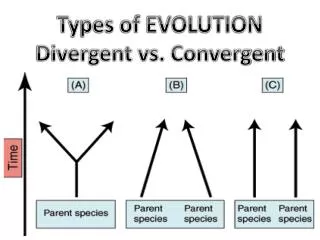
2 types of evolution Macroevolution Microevolution Changes within a gene pool Examples: Kettleworth moths Insect resistance Drug resistance • Changes beyond the species • Examples: • Biogeography • Fossil record • Homology • Biochemical similarities • Chromosomal similarities
1. Biogeography: the geographic distribution of species • Why does the Arctic have polar bears and Antarctica penguins?
Why are most of the species on islands more closely related to species on the nearest mainland. • The answer is that modern species are where they are because they evolved from ancestors that inhabited those regions. • In the case of island species, inhabitants must have migrated from the original, mainland area where the species originated.
On a global scale, we now know that the distribution of species is based upon continental drift.
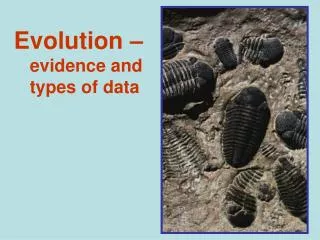
2. Fossils How are fossils formed? • Preservation in sap • Mineral replacement • Preservation in ice • Traces e.g. footprints • Molds
I. Fossils • Fossils are the preserved remains of ancient organisms.
The succession of fossil forms is congruent with the theory of descent with modification. • Ex. Extinct intermediate forms in whale evolution.
Ambulocetus natans in action. A reconstruction of an early close cousin of whales.
Why is it true that fossil fishes predate fossil amphibians which predate fossil reptiles which predate fossil mammals?
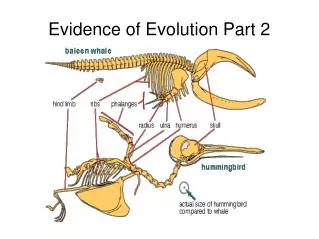
b. Vestigial organs • Vestigial organs are remains of a structure that was functional in some ancestor but is no longer functional in the organism in question. • For example, humans have a tail bone (the coccyx) but no tail. The presence of vestigial structures is explained by the common descent.
4. Comparative Embryology: • A comparison of the early stages of their embryonic development may show similarities that suggest a common ancestry. • For example, the early embryos of fish, birds, pigs and humans closely resemble one another.
5. Molecular Biology/Biochemical Similarities • DNA, RNA, amino acids and proteins have all been used to determine evolutionary relationships between organisms • For example: Cytochrome C (in ETC) is used by organisms ranging from yeast to humans • The greater the differences in the DNA bases that code for the cytochrome C enzyme, the longer the time since two organisms shared a common ancestor.
Human beta chain 0 Gorilla 1 Gibbon 2 Rhesus monkey 8 Dog 15 Horse, cow 25 Mouse 27 Gray kangaroo 38 Chicken 45 Frog 67 Lamprey 125 Sea slug (a mollusk) 127 Soybean (leghemoglobin) 124 An example of molecular homology. • The numbers is equal to the number of amino acid differences between human hemoglobin and others.
A phylogenetic "tree of life" constructed by computer analysis of cyochrome c molecules in the organisms shown
Why don’t pesticides work very long? Entomologists say 500 crop pests have already evolved resistance to conventional insecticides.
Insecticide Resistance • Currently over 500 pests are resistant to 1 or more common insecticides • Through mutations the insect does not produce enzyme which interacts with the poison
Drug Resistance • H1N1, MRSA, HIV drug resistance • Caused by decades of excessive and unnecessary use of antibiotics In 1943, penicillin was introduced as an antibiotic to protect against Staphylococcus infections. By 1946, a number of strains of Staphylococcus demonstrated resistance to penicillin. Today, as many as 80% of Staphylococcus aureus are resistant to penicillin.
Prior to the industrial revolution, there was a much higher frequency of the light variety of the peppered moth, which, were adapted to the light colored lichen on tree bark. • However, industrial pollution in the 1800’s began to kill the lichen, turning the tree bark into a dark color. • Now, the number of dark variety of peppered moth increased i.e. were naturally selected.
So how fast can you mutate? • Animals and plants are about 1/100,000 mitotic cells • Bacteria reproduce by binary fission and mutate about the same….but they multiple every 20 minutes!!! A single bacteria can reproduce so fast that after 36 hrs, there would enough bacteria to cover the Earth 1 foot deep.
Sexual Reproduction • Genetic variation in sexual reproduction increases • No way to estimate amount of genetic variation • Sexual reproduction promotes genetic variation
The genetic structure of a population. Some basic definitions: • A population is a group of individuals belonging to the same species. • A species is a group of populations whose individuals can successfully interbreed. • A gene pool is the total genes in a population a any one time. It consists of all alleles at all gene loci in all individuals of the population.