Cardiovascular TE mini-presentations
This presentation delves into the latest advancements in cardiovascular tissue engineering, focusing on heart structures at the microscale. It covers critical aspects including the design of scaffolds for tissue regeneration, the role of various cell sources, and techniques in histology and immunohistochemistry for effective tissue preparation. By understanding the architecture, compatibility, and bioactivity of engineered tissues, we can better promote three-dimensional cellular growth and ultimately repair or replace defective heart tissues.

Cardiovascular TE mini-presentations
E N D
Presentation Transcript
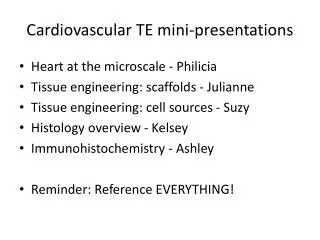
Cardiovascular TE mini-presentations • Heart at the microscale- Philicia • Tissue engineering: scaffolds - Julianne • Tissue engineering: cell sources - Suzy • Histology overview - Kelsey • Immunohistochemistry - Ashley • Reminder: Reference EVERYTHING!
Cells in a Heart • cardiac muscle and connective tissue. • myocytes • complete mixture of: collagen fibrils, elastin, cells including fibroblasts and macrophages, macromolecules such as glycoproteins, and glycosaminoglycans together with other molecules such as growth factors, cytokines, and extracellular proteases http://www.cellsalive.com/myocyte.htm http://en.wikipedia.org/wiki/Heart http://ajpheart.physiology.org/content/289/3/H973.full
Tissue Engineering Scaffolds Replace, restore, regenerate defective tissue Tissue engineering triad Functions and Features: • Architecture • Tissue Compatibility • Bioactivity • Mechanical Property Cells are ‘seeded’ into the scaffold to promote 3D growth Figure 1: Engineered Vascular Graft Figure 2: Difference between porous PEG/PBT and cartilage grafts
Works used/ Good resources http://www.ncbi.nlm.nih.gov/pmc/articles/PMC2587658/ http://en.wikipedia.org/wiki/Tissue_engineering#Scaffolds Images: http://www.nature.com/nmat/journal/v4/n7/fig_tab/nmat1421_F6.html http://en.wikipedia.org/wiki/File:Gef%C3%A4%C3%9Fprothese.JPG
TE Cell Sources • Tissue engineering uses primary cells -> cells from organisms • American Type Culture Collection • NIH • Biotechnology companies • Invitrogen • Cell banks • Can borrow from other labs but risk contamination!
Histology: Tissue Preparation • Fixation– preserve the sample by killing the tissue and bacteria (formalin, Picric acid) • Dehydration – replace water in sample with ethanol • Clearing - replace ethanol with xylene (increase transparency) • Embedding – replace xylene with paraffin (Infiltration typically occurs in an oven at 58 -60°C) • Sectioning– trim and slice the tissue/paraffin block into thin sections (should make a ribbon of samples in successive order) • Mounting - place onto microscope slides (pretreated with egg albumen adhesive) • Staining – differentiate between the acid and basic components of the cells or the fibrous components of the extracellular matrix; stain with fluorescent molecule or radioactive isotope or dye
http://www.piercenet.com/browse.cfm?fldID=F95B91A9-3DC1-4B56-8E8D-59CA044A8BA7http://www.piercenet.com/browse.cfm?fldID=F95B91A9-3DC1-4B56-8E8D-59CA044A8BA7 • http://www.youtube.com/watch?v=mpK5ojrXQs0