Understanding the Second Tutorial on Finding Acceleration and Velocity
Learn how to calculate acceleration and velocity in dynamic systems by solving equations and applying material science principles. Discover how stresses and strains impact design considerations in engineering.

Understanding the Second Tutorial on Finding Acceleration and Velocity
E N D
Presentation Transcript
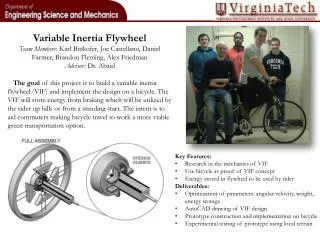
Flywheel Problem The Second Tutorial
Finding acceleration and velocity y r = xex+yey = rer er=cosθex+sinθey z eθ er r yey v = d/dt(rer) a=d/dt(d/dt(rer)) x xex
Finding acceleration and velocity v=ωr eθ v=d/dt(rer)=r*d/dt (cosθex+sinθey) v= r*(-sinθ*(dθ/dt) ex+cos θ*(dθ/dt)ey ) (1) Now a=dv/dt= d/dt(ωr eθ) = ωr*d/dt(eθ) • Now recall that: • eθ= (cosθex - sin θey) • ω=(dθ/dt) This becomes: a=- ω2r er Substitution into (1) gives the form: v=ωr eθ (2)
Kinetic Energy • K=(1/2)I*ω2 where I = ∫r2dm • I= ∫ ρ r2dV = ∫∫∫ρ r2 dtdrdθ = (2πρtR4)/4 • dθ=2πrdr • ∫dt=t, thickness Substitution gives: K=(1/4) πρtR4ω2
Material consideration • Yield- At high speeds centrifugal forces cause tensile strength • Material needs to be designed resistant to these stresses • Young’s modulus and Possion’s ratio must be accounted for in design
Stress-Strain relations • Assuming plane stress t<<R • Use Strain-Displacement relationships given: • ur=u(r), uz, uθ=rωt εrr=d/dθ(ur), εθθ=(1/r)d/dθ(uθ) + ur/r, εzz=d/dz (uz) εθr= (1/2)(d/dz(uθ) +r-1d/dθ(uz)-uθ/r) εθz=(1/2)(d/dz(uθ)+r-1d/dθ(uz)) εrz=(1/2)(d/dr(uz)+d/dz(ur))
Stress-Strain relations Simplifying we find that: εrr=d/dθ(ur), εθθ=ur/r, εzz=d/dz (uz) εθr= (1/2)(d/dz(uθ) +r-1d/dθ(uz)-uθ/r) = 0 εθz=(1/2)(d/dz(uθ)+r-1d/dθ(uz)) = 0 εrz=(1/2)(d/dr(uz)+d/dz(ur)) = 0
Stress-Strain relations Using the governing Stress-Strain relation: σij= (E/(1+ν) [εij + (v/(1-2v))(Σ εkk)δij] σθz = σrz = σrθ=0 σzz=(E/(1-v2))(εrr+vεθθ) = 0 (from assumption) σrr=(E/(1-v2))(εrr+vεθθ) σθθ=(E/(1-v2))(vεrr+εθθ)
Equation of Motion for ur Since looking for ur use the following Equation of Motion: d/dr(σrr)+r-1d/dθ(σrθ)+d/dz(σrz)+(1/r)(σrr- σθθ)=ρd2/dt2(ur) (ignores body force ρbr) Using the stresses derived earlier we can simplify to the following: d/dr(σrr)+(1/r)(σrr- σθθ)=ρd2/dt2(ur)= -ρω2r d2/dr2(ur)+(1/r)(d/dr(ur))- (ur)/r2= -[ρω2r(1-v2)]/E (3)
Equation of Motion for ur d2/dr2(ur)+(1/r)(d/dr(ur))- (ur)/r2= -[ρω2r(1-v2)]/E (3) This equation will solve for ur. But first re-write using reverse chain rule: d/dr[(1/r)(d/dr(urr))]=-[ρω2r(1-v2)]/E Integrating yields the solution: ur=Ar+Br-1-[((1-v2)/8E)ρω2r3
Stress field • Using the stress-strain and the strain-displacement relations derived earlier σrr=(E/(1-v2))(εrr+vεθθ) σθθ=(E/(1-v2))(vεrr+εθθ) εrr=d/dθ(ur), εθθ=ur/r, εzz=d/dz (uz) Plug into new equation for ur setting boundary conditions: σr(R)=0 (no mass rotating and pulling on outside) ur(0)=0 no displacement in the r direction at center
Stress field • After solving for “A” and “B” substitute to • obtain final Stresses σrr=ρω2(3+v)/8[(R2)(1-(r/R)2)] σθθ=(R2ρω2(3+v)/8 )[1-(r/R)2((1+3v)/(v+3))] • When r=0 you get the maximum stress σrr=σθθ=(R2ρω2(3+v))/8
Product bound Plug in max stresses to mises yield condition to obtain: σ(mises)= σ(max) σ(max)<σ(yield) ωR< 2(2σ(yield)/(ρ(3+v))).5