Download
1 / 25
250 likes | 371 Views
Explore the multifaceted nation of Japan through its geography, major islands, waterways, and historical events. This overview includes key insights on the four major islands: Hokkaido, Honshu, Shikoku, and Kyushu, as well as significant waterways like the Pacific Ocean and Sea of Japan. Delve into Japan's rich history from its isolation in the 1600s to key moments in World War II, including the attack on Pearl Harbor and the aftermath of nuclear bombings in Hiroshima and Nagasaki. A comprehensive guide for students studying Japan's geography and history.

E N D
Japan Mr. Napier
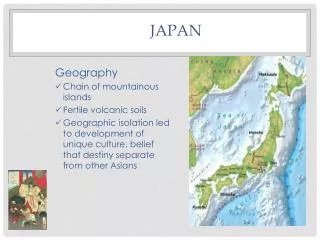
JapanGeography • Label the four major islands • Hokkaido • Honshu • Shikoku • Kyushu • Label the major waterways • Pacific Ocean • Sea of Japan • Korea Strait • Label Tokyo with a star
Hokkaido Sea of Japan Honshu Pacific Ocean Korean Strait Shikoku Kyushu
Homework • Read pages 681 to 686. • Write out answers to Chart Skills questions (2) on page 686. • Questions 3, 4, 5. • Due 10-7
Japan • Mark the location of each of these cities with a dot and a label. • Osaka • Kyoto • Hiroshima • Nagasaki • Sapporo • Mark the location of Mt. Fuji with a triangle and label.
Japan Map Questions • On which island is Tokyo located? • Which of the four islands is the largest? • Which of the four islands is the smallest? • What city is located on the island of Hokkaido? • What is the name of the volcanic peak located on the island of Honshu? • Which body of water separates the island of Kyushu and South Korea? • Which island is northernmost in Japan? • Which island is southernmost in Japan? • Which city is further west: Osaka or Tokyo? • From its widest point east to west, is the island of Kyushu more or less than (or equal to) 150 miles wide?
Facts about Japan • Archipelago splitting North Pacific Ocean and Sea of Japan. • Just east of Korea • Four islands • Hokkaido • Honshu • Shikoku • Kyushu Size of California
Earthquakes – Ring of Fire • Japan has about 1,500 per year. • Intersection of three tectonic plates • Construction is designed to withstand earthquakes
Earthquake - 2011 • 8.9 on Ricker Scale (largest in history of Japan) • Nearly 16,000 killed • About 130,000 buildings collapsed
Mountains and Volcanoes • Mostly rugged hills, mountains and valleys. • Mt. Fuji • Tallest (12,388 feet) • Active volcano (1707) • Sacred in Shinto tradition • Located between Tokyo and Osaka
Japan’s Climate • Tropical in the south • Warm and rainy • Temperate in the north • Four seasons • Monsoons • Bring cold rain and snow in winter and warm rain in summer • Typhoons • Hurricanes in Pacific • Summer and early Fall
Shinto • Religion which means “the way of the gods” • Teaches that supernatural beings called Kami live in all objects and forces of nature • Wind, rain, mountains, trees and rivers • No founder or sacred scriptures • Shrines are center of religious practice
History of Japan • Isolated from 1600’s to 1800’s. • Traded only with China • Ports opened by U.S. in 1850’s. • U.S. Navy sent large fleet • Commodore Perry negotiated a treaty that opened trade.
Japan – Early 1900’s • Ally of U.S. and Allies in World War I • Major earthquake in 1923 (8.3 on Richter) • Great Depression • Invaded China in 1933 • Ally of Germany in WWII – U.S. stopped oil • Attacked Pearl Harbor
I’m afraid we have awakened a sleeping giant and filled it with terrible resolve. Admiral Yamamoto
Pearl Harbor • “ Yesterday, December 7th, 1941 – a date which will live in infamy – the United States of America was suddenly and deliberately attacked by naval and air forces of the Empire of Japan” FDR to Congress • Many U.S. Battleships destroyed • Over 2,000 killed • Carriers at sea • U.S. declares war
World War II • Japan conquered most of Asia including Philippines and Indo-China. • Battle of Midway • Turning point • U.S. destroys Japanese carriers • Guadalcanal – first U.S. land offensive • Island Hoping – U.S. captures island with airfield and cuts off Japanese supplies
End of WWII in Asia • U.S. captures islands close to Japan • Guam • Iwo Jima • Okinawa • U.S. bombs Hiroshima (August 6, 1945), then Nagasaki (August 8, 1945) • Emperor surrenders on September 1, 1945
Performance Task • Due October 17, 2014 • Product – Poster/Presentation • Illustrate and present the life of a person of your age, gender and standard of living in either Korea, Japan or China. • First hand info will receive extra credit! Can you find an individual to talk with via e-mail?
Warm Up • Why did Japan attack Pearl Harbor? • Why did Japan seek to control areas of Asia before the start of World War II? • What was the U.S. military strategy in the Pacific during World War II? • How did Commodore Perry impact the history of Japan? • Name three major battles of World War II?