Download
1 / 12
120 likes | 294 Views
Datalog is a declarative logic programming language primarily used for databases. It comprises a finite set of rules that connect input and defined relations, facilitating queries about data. Each rule has a head and body, expressing relationships through specified predicates. This document outlines various examples, including finding social security numbers, paths in graphs (Hamiltonian cycles), and travel times between cities. The semantics of Datalog queries, such as proof-based and least fixed-point semantics, are also discussed, showcasing their application in reasoning about database relations.

E N D
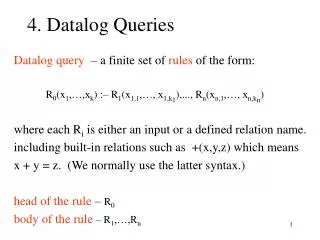
4. Datalog Queries Datalog query– a finite set of rules of the form: R0(x1,…,xk) :– R1(x1,1,…, x1,k1),..., Rn(xn,1,…, xn,kn) where each Ri is either an input or a defined relation name. including built-in relations such as +(x,y,z) which means x + y = z. (We normally use the latter syntax.) head of the rule – R0 body of the rule– R1,…,Rn
Example: Find the SSN and the tax. Tax_Due(s, t) :– Taxrecord(s, w, i, c), Taxtable(inc, t), w+i+c = inc. Find the streets that can be reached from (x0,y0). Reach(n) :– Street(n, x0, y0). Reach(n) :– Reach(m), Street(m, x, y), Street(n, x, y). Find the time to travel from x to y. Travel(x, y, t) :– Go(x, 0, y, t). Travel(x, y, t) :– Travel(x, z, t2), Go(z, t2, y, t).
Example: Find town points covered by a radio station Covered(x2, y2) :– Broadcast(n, x, y), Town(t, x2, y2), Parameters(n, s, blat, blong), Parameters(t, s2, tlat, tlong), x2 = x + (tlat – blat), y2 = y + (tlong – blong).
4.2 Datalog with Sets Example: Hamiltonian Cycle Input: • Vertices(S) where S is a set of vertices • Edge ({c1}, {c2}) if there is an edge from c1 to c2 • Start({c}) where c is start city name Output: • Path ({c}, B) if there is a path from c that uses all vertices except those in B. • Hamiltonian ({c}) if there is a Hamiltonian path.
Base case – Path is a single vertex. All vertices except the start vertex is unvisited. Path(X1, B) :– Vertices(A), Start(X1), B = A \ X1. Recursion – a path to X1 with B unvisited exists if there is Path(X1, B) : – Path(X2, A), a path to X2 with A unvisited Edge(X2, X1), and an edge from X2 to X1, X1 A, which is unvisited, and B = A \ X1. B is A minus X1
If there is a path from start to X2 that visits all vertices and an edge from X2 to start, then there is a Hamiltonian cycle. Hamiltonian(X1) :– Path(X2, ), Edge(X2, X1), Start(X1).
4.4 Datalog with Abstract Data Types Example: Streets(Name, Extent) where extent is a set of 2D points. Let (x0, y0) be a start location. Express the reach relation: Reach(n) :– Street(n, Extent), {(x0,y0)} Extent. Reach(n) :– Reach(m), Street(m, S1), Street(n, S2), S1 S2
4.5 Semantics Rule instantiation – substitution of variables by constants ⊢Q,I R(a1,…..ak)– R(a1,….ak) has a proof using query Q and input database I, iff • R represents input relation r and (a1,….ak) r , or • There is some rule and instantiation R(a1,…,ak):–R1(a1,1,…,a1,k1),…, Rn(an,1,…, an, kn). where ⊢Q,I Ri(ai,1,…,ai,ki) for each 1 i n .
Example: Reach(Vine) Reach(Vine) :– Street(Vine, 5, 2). Reach(Bear) Reach(Bear) :– Reach(Vine), Street(Vine, 5, 12), Street(Bear, 5, 12). Reach(Hare) Reach(Hare) :– Reach(Bear), Street(Bear, 8, 13), Street(Hare, 8, 13).
Example: By the input database (Figure 1.2): Go(Omaha, 0, Lincoln, 60) Go(Lincoln, 60, Kansas_City, 210) Go(Kansas_City, 210, Des_Moines, 390) Go(Des_Moines, 390, Chicago, 990) We also have: Travel(Omaha, Lincoln, 60) Travel(Omaha, Lincoln, 60):- Go(Omaha, 0, Lincoln, 60) Travel(Omaha, Kansas_City, 210) Travel(Omaha,Kansas_City,210):- Travel(Omaha,Lincoln,60), Go(Lincoln,60,Kansas_City,210).
Proof-based semantics – derived relations are the set of tuples that can be proven. Fixed point semantics – an interpretation of the derived relations such that nothing new can be proven. Least fixed point semantics – smallest possible FP semantics. Proof-based semantics = Least fixed point semantics