Understanding the Heart and Cardiovascular System: Structure and Function
The cardiovascular system comprises the heart and blood vessels, crucial for circulating blood that transports oxygen, nutrients, and waste. Located beneath the 2nd rib, the heart measures approximately 14 cm long and 9 cm wide. It features a "skeleton" of dense connective tissue and is encased in the pericardium, which reduces friction through its fluid-filled cavity. The heart comprises three layers: epicardium, myocardium, and endocardium, and has four chambers (two atria and two ventricles) that play key roles in blood circulation, including valves and functional processes essential for effective pumping.

Understanding the Heart and Cardiovascular System: Structure and Function
E N D
Presentation Transcript
Cardiovascular System • Consists of the heart and blood vessels • Circulates blood in order to transport oxygen, nutrients, and wastes
The Organ • Located beneath 2nd rib • Avg. size: 14cm long 9 cm wide • Base – attached to blood vessels • Apex – points down & left
The Organ • Has a “skeleton” • Rings of dense connective tissue • Covered by a sac = pericardium • Consists of dense connective tissue surrounding serous membrane • Space in-between = pericardial cavity • Contains fluid to reduce friction
The Walls Consists of 3 walls: • Epicardium = connective tissue & epithelium • Blood & lymph capillaries, nerve fibers • Myocardium = cardiac muscle • contraction • Endocardium = epithelium & connective tissue • Blood vessels, specialized muscle fibers • Continuous with inner lining of vessels
The Chambers • 4 chambers • Top 2 = atria • Thin walls, receive blood • Separated by interatrial septum • Bottom 2 = ventricles • Thicker walls, force blood out • Separated by interventricular septum
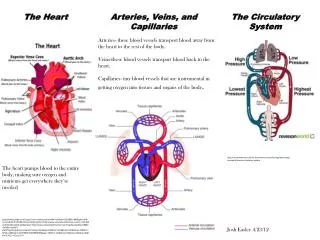
The process – Part 1 • Right atrium receive blood from tissues • From superior & inferior vena cava • Low O2 • Right atrium contracts • Tricuspid valve allows blood from right atrium into the right ventricle • 3 flaps • Prevents backflow as well
The process – Part 1 • Right ventricle contracts • Tricuspid valve closes • Pulmonary valve opens • Exit called the pulmonary trunk • Trunk splits into right and left arteries and takes blood to lungs
The process – Part 2 • Left atrium receive blood from lungs • 4 pulmonary veins • Left atrium contracts • Mitral valve allows blood from left atrium into the left ventricle • 2 flaps • Prevents backflow as well
The process – Part 2 • Left ventricle contracts • Mitral valve closes • Aortic valve opens • Exit into aorta • Left ventricle relaxes which closes aortic valve • Aorta branches to distribute blood throughout the body
Valve Control • Fibrous strings called chordaetendineae prevent the flaps of the mitral and tricuspid valves from swinging backwards into the atria