Download

1 / 0
Imperialism
0 likes | 252 Views
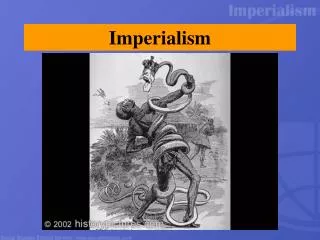
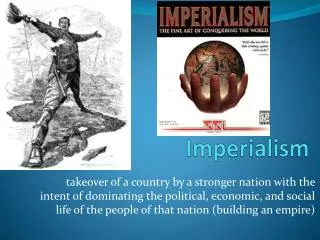
Imperialism. World History: 1750 - Present. Imperialism. Imperialism: the domination by one country of the political, economic, or cultural life of another country or region. Imperialism. Like Great Britain, other Western countries built overseas empires in the late 1800s

Download Presentation 
Imperialism
An Image/Link below is provided (as is) to download presentation
Download Policy: Content on the Website is provided to you AS IS for your information and personal use and may not be sold / licensed / shared on other websites without getting consent from its author.
Content is provided to you AS IS for your information and personal use only.
Download presentation by click this link.
While downloading, if for some reason you are not able to download a presentation, the publisher may have deleted the file from their server.
During download, if you can't get a presentation, the file might be deleted by the publisher.
E N D
Presentation Transcript
-
Imperialism
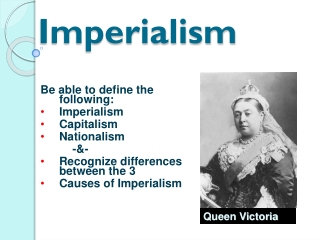
World History: 1750 - Present - Imperialism Imperialism: the domination by one country of the political, economic, or cultural life of another country or region
- Imperialism Like Great Britain, other Western countries built overseas empires in the late 1800s The Industrial Revolution gave the West the economic and political might to dominate the world
- Economic Reasons Imperialism
- Economic Reasons The Industrial Revolution created needs and desires that spurred overseas expansion Manufacturers needed access to rubber, petroleum, metals, and oil
- Economic Reasons Also, the West saw the rest of the world as a new market to whom they could sell their goods
- Military Reasons Imperialism
- Military Reasons Steam-powered merchant ships and naval vessels needed bases around the world to take on coal and supplies Industrial powers seized islands and harbors to satisfy these needs
- Humanitarian & Religious Reasons Imperialism
- Humanitarian & Religious Reasons Many Westerners felt a genuine concern for the less-fortunate around the world Missionaries spread the Christian religion
- Humanitarian & Religious Reasons Doctors spread medicine Laws, political beliefs, and cultures were also spread
- Social Darwinism Imperialism
- Social Darwinism Charles Darwin believed that the prevailing law in nature was “survival of the fittest” Many Westerners began to apply these principals to human societies
- Social Darwinism They believed that white, European races were superior to all others Therefore, domination of “weaker” races was nature’s way of improving the species
- How the West Won Imperialism
- How the West Won The West had many advantages over other powers: Strong economies Well-organized governments Powerful militaries Better technology Better medicine
- Backlash Imperialism
- Backlash Within Western nations, a small group of anti-imperialists emerged They argued that colonialism was a tool of the rich and that Westerners were moving towards greater democracy at home, but were imposing undemocratic rule over others
- Scramble for Africa Imperialism
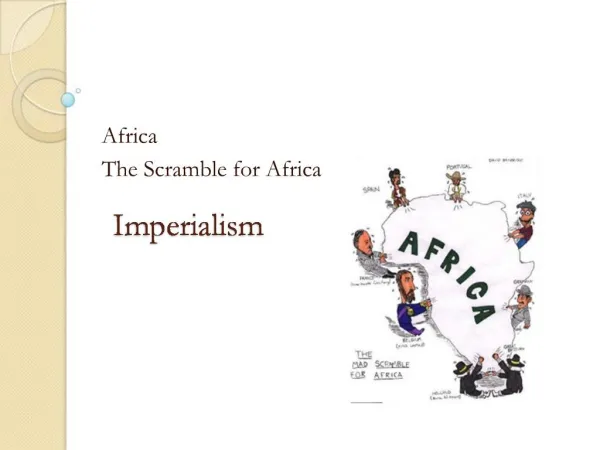
- Scramble for Africa In the late 1800s, Britain, France, Germany, and other European nations began to carve up the African continent
- Scramble for Africa From the 1500s through the 1700s, Europeans traded along the African coast Europeans did not travel much into the interior of Africa
- Scramble for Africa Instead, Europeans paid or traded with Africans along the coast and had them travel into the interior for goods and slaves Why did Europeans not travel into the interior of Africa?
- Scramble for Africa Resistance by other Africans Difficult geography New diseases
- Scramble for Africa In the early 1800s, medical advances and steamships allowed Europeans to advance to Africa’s interior The best-known explorer of Africa was Dr. David Livingstone
- Scramble for Africa Livingstone crisscrossed Africa for 30 years Livingstone was opposed to the slave trade and tried to open up Africa to traders and missionaries
- Scramble for Africa In the 1870s, Belgium’s King Leopold II hired Henry Stanley to explore the Congo River and arrange trade treaties with African leaders
- Scramble for Africa Other nations followed Leopold’s lead and set off to create trade relations with African leaders To avoid bloodshed, European powers met at an international conference in Berlin in 1884
- Scramble for Africa At the conference, leaders agreed that no European power could claim any part of Africa unless it had set up a government office there This led Europeans to quickly send officials across Africa
- Scramble for Africa No Africans were invited to the conference In less than 20 years, almost all of Africa was partitioned
- Scramble for Africa As Europeans carved out their claims, they redrew the borders of Africa with little regard for traditional boundaries and frontiers
- Scramble for Africa Belgium took control of the Congo France took over much of North Africa, and parts of West and Central Africa
- Scramble for Africa At its height, the French Empire in Africa was as large as the United States
- Scramble for Africa Britain’s share of Africa was more scattered than that of France However, it included more heavily populated areas with many more resources
- Scramble for Africa Britain had colonies in western and eastern Africa, including Egypt and Sudan Britain acquired the Cape Colony in southern Africa from the Dutch in 1814
- Scramble for Africa In Cape Colony, Britain clashed with the Boers Boers: descendents of Dutch settlers
- Scramble for Africa When Britain took over, many Boers fled north and set up their own republics In the late 1800s, the discovery of gold and diamonds in Boer lands led to conflict with Britain
- Scramble for Africa The Boer War lasted from 1899 to 1902 and involved bitter guerilla warfare In the end, the British won, but at the cost of many lives
- Scramble for Africa In 1910, the British united Cape Colony and the former Boer republics into the Union of South Africa The new constitution set up a government run by whites and laid the foundation for a system of complete racial segregation
- Scramble for Africa The Portuguese created colonies in Central Africa Italy established Libya in North Africa and also colonies on the “horn” of Africa
- Scramble for Africa Germany took lands in eastern and southwestern Africa Europeans met armed resistance across the continent
- Scramble for Africa The Algerians battled the French for years The British fought the Zulus in southern Africa and the Asante in West Africa
- Scramble for Africa In East Africa, the Germans fought wars against the Yao and Herero The Germans met especially fierce in the Maji-Maji Rebellion of 1905
- Scramble for Africa The Germans triumphed only after burning acres and acres of farmland, leaving thousands of local people to die of starvation
- Scramble for Africa Ethiopia, an ancient Christian kingdom in East Africa, managed to maintain its independence
- Scramble for Africa Ethiopia was divided among rival princes who ruled their own domains In the late 1800s, Menelik II, one of the domain rulers, hired European experts to plan modern roads and bridges and set up school systems
- Scramble for Africa Menelik II also imported weapons and European officers to help train his army When Italy invaded Ethiopia in 1896, Menelik was prepared
- Scramble for Africa The Ethiopian army smashed the Italian military Ethiopia and Liberia were the only lands in Africa to maintain their independence
- Scramble for Africa During the “Scramble for Africa,” a new, western-educated elite emerged Some middle-class Africans admired Western culture and rejected their own culture
- Scramble for Africa Others valued their African traditions and condemned Western societies By the early 1900s, African leaders were forging nationalist movements to pursue independence
- Egypt Imperialism
- Egypt In the early 1800s, Egypt was a province of the Ottoman Empire After a Civil War, Muhammad Ali, an Egyptian soldier, became the governor of Egypt
- Egypt Ali is sometime called the “father of modern Egypt” He introduced economic reforms, backed large irrigation projects, expanded cotton production, and brought in Western military experts to build a powerful army
- Egypt Ali used the new military to conquer Arabia, Syria, and Sudan Ali’s successors were not as strong and when Ali died in 1849, western influence increased
- Egypt In 1858, a French entrepreneur, Ferdinand de Lesseps, organized a company to build the Suez Canal Construction began in 1859 and took 10 years to complete
- Egypt The Suez Canal is more than 100 miles long and connects the Mediterranean and Red Seas This meant that ships no longer had to sail around Africa to get to Asia
- Egypt The canal reduced the trip from London to India by over 5,000 miles Europeans gained control over the Ottomans by extending loans with very high interest rates
- Egypt In 1875, the ruler of Egypt could not repay his loans To pay his debts, he sold his share (a controlling interest) of the Suez Canal to Britain
- Egypt Egyptian nationalists revolted against foreign influence in 1882, loosening Ottoman control Britain then made Egypt a protectorate Protests and riots still flared in Egypt
- Persia Imperialism
- Persia Since 1794, Persia had been ruled by the Qajar dynasty Britain and Russia vied for influence in the region
- Persia Britain wanted to protect its interests in India, while Russia wanted to protect its southern borders In the early 1900s, oil was discovered in Persia
- Persia Both Russia and Britain made the Persian government grant them concessions Concessions: special rights given to foreign powers
- Persia To protect their interests, Britain and Russia both sent troops into Persia Persian nationalists were outraged
- Persia Two groups of nationalists emerged One group wanted to adopt Western ways The other, led by Muslim religious leaders, condemned both the Persian government and Western influences
- India
- India India was ruled by the Mughal dynasty In the early 1600s, the British East India Company gained trading rights in India
- India As Mughal power declined, the British exerted more and more influence British officials introduced Western education, missionaries traveled to India, worked to end slavery, and tried to improve the position of women in India
- India The British passed a law that banned sati (SUH tee) Sati was a Hindu custom that called for a widow to join her husband in death by throwing herself on his funeral fire
- India The British made sepoys serve anywhere the government commanded Sepoys: Indian soldiers in the British service
- India This was an offense to high-caste Hindus who believed it was an offense against their religion In 1857, the British issued new rifles to the sepoys
- India Troops were told to bite off the tips of the cartridges before loading them However, the cartridges were greased with cow and pig fat
- India Cows were sacred to Hindus and pigs were forbidden to Muslims When troops refused to load the rifles, they were imprisoned
- India Angry sepoys rose up against the British officers Known as the Sepoy Rebellion, many British men, women, and children were brutally massacred
- India The British soon rallied and crushed the revolt The British then took revenge by burning villages and slaughtering thousands of unarmed Indians
- India The British sent more troops to India and taxed Indians to support the extra soldiers The British also passed a law that allowed Hindu widows to remarry, angering many Hindu believers
- India After the Sepoy Rebellion ended, Britain set up a new government in India, known as the British Raj A British viceroy in India governed in the name of the queen and British officials held the top positions in government
- India The British admired their work in India so much that it became known as the “brightest jewel” in the crown of their empire
- India The British Raj improved transportation, communication, agriculture, medicine, education, and revised the legal system
- India Thanks to the reforms of the British, a class of Western-educated Indians emerged By the mid/late 1800s, these “elites” began forming nationalist movements
- India In 1885, nationalist leaders formed the Indian National Congress The INC sought eventual self-rule, but supported Western-style modernization
- India In 1906, Muslim nationalists in India formed the Muslim League Some even called for a separate Muslim state
- China Imperialism
- China During the late 1700s, British merchants began making huge profits by trading opium grown in India for Chinese tea Knowing the harsh effects of the drug, opium had already been outlawed in Britain
- China Soon, many Chinese had become addicted to the drug The Chinese government outlawed opium and executed Chinese drug dealers
- China The Chinese told the British to stop the trade, but the British refused In 1839, Chinese warships clashed with British merchants, triggering the Opium War
- China The British defeated the Chinese in 1842 The Opium Wars ended with the Treaty of Nanjing
- China According to the Treaty of Nanjing, the Chinese had to pay a huge indemnity to the British Indemnity: payment for loses in a war
- China The Treaty also gave the British control of Hong Kong British citizens living in China were also given extraterritoriality
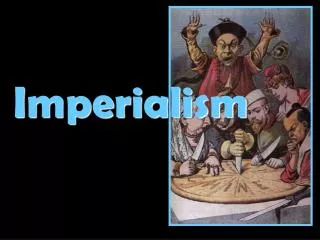
- China Extraterritoriality: the right to live under the laws of one’s home country, while living in another country The Treaty of Nanjing was the first of a series of “unequal treaties” that forced China to make concessions to Western powers
- China Chinese nationalists were furious Hong Xiuquan, a village schoolteacher, led the Taiping Rebellion
- China The Taiping Rebellion sought to overthrow the Qing dynasty and turn China into a “Heavenly Kingdom of Peace” The rebellion lasted 14 years, with the rebels gaining control of large parts of China
- China The Qing dynasty eventually toppled the rebellion, but lost even more power 20 to 30 million Chinese died in the rebellion
- China: 1st Sino-Japanese War Imperialism
- China: 1st Sino-Japanese War Resenting the West and relying on its agriculture, many Chinese refused to modernize Japan, China’s neighbor, modernized in 1868 By the late 1800s, Japan had a powerful military
- China: 1st Sino-Japanese War The Japanese went to war with China over control of Asian lands between the two countries It was known as the Sino-Japanese War
- China: 1st Sino-Japanese War After bitter fighting, China agreed to give Japan the island of Taiwan and agree to pay Japan an indemnity
- China: 1st Sino-Japanese War After China’s defeat, European powers swept in and carved out “spheres of influence” in China In 1898, Emperor Guang Xu (gawahng shoo) launched the Hundred Days of Reform
- China: 1st Sino-Japanese War The Hundred Days of Reform called for modernization of the military, government, schools, and other organizations Conservatives rallied against the reforms and had the emperor imprisoned
- China: Boxer Rebellion Imperialism
- China: Boxer Rebellion Chinese conservatives began threatening Christian missionaries The Conservatives stated that the missionaries threatened Confucianism
- China: Boxer Rebellion Foreign troops also angered the nationalists Thanks to extraterritoriality foreigners ignored Chinese laws and traditions
- China: Boxer Rebellion The resentment against foreigners finally boiled over In 1899, a group of Chinese formed a secret society – the Righteous Harmonious Fists
- China: Boxer Rebellion Westerners, watching the group train in martial arts, dubbed them “boxers” The goal of the Boxers was to drive out foreigners
- China: Boxer Rebellion In 1900, the Boxers attacked foreigners, especially missionaries, across China In response, Japan and the western powers organized a multinational force
- China: Boxer Rebellion The force crushed the Boxer Rebellion and forced the Chinese to accept even more concessions The loss finally forced China to modernize
- China: Republic Imperialism
- China: Republic China admitted women to schools and placed more importance on science and math than on Confucian thought A large number of students were sent to study abroad
- China: Republic By the early 1900s, China had adopted a constitutional monarchy In 1911, peasants, students, local warlords, and court politicians finally toppled the Qing dynasty
- China: Republic In December of 1911, Sun Xian was named the president of the Chinese Republic Although reforms had been made, China was still at constant war with itself or foreigners
- The End

More Related