Overview of the Circulatory System: Blood and Lymphatic Vascular Components
This comprehensive overview covers the essential functions and structures of the circulatory system, highlighting the transport of nutrients, hormones, and gases. It explains the two main circulatory systems: the blood vascular system, which includes the heart, arteries, veins, capillaries, and their respective layers, and the lymph vascular system, consisting of lymphatic vessels and ducts. Detailed descriptions of vessel types, including elastic and muscular arteries, small arteries, arterioles, and veins, showcase their anatomical differences and functions in maintaining circulatory efficiency.

Overview of the Circulatory System: Blood and Lymphatic Vascular Components
E N D
Presentation Transcript
CIRCULATORY SYSTEM Dr Iram Tassaduq
OVERVIEW • Transport of nutrients, hormones, gases, & other vital materials requires highly controlled flow. • Body has 2 circulatory systems. • Blood vascular system • Lymph vascular system
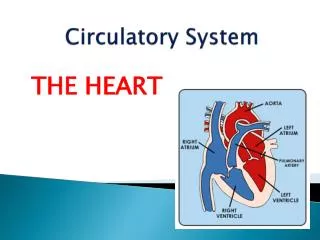
BLOOD VASCULAR SYSTEM • The heart, which is a pump for propelling the fluid. • The arteries which are tubes for conveying the blood toward the organs & tissues. • The capillaries, which are anastomosing channels of small caliber with thin walls providing for much of the interchange of substances between the blood & tissue fluids. • The veins, which in their initial segment also provide for blood-tissue fluid interchange but in addition serve for the return of blood to the heart.
LYMPH VASCULAR SYSTEM • Consists of lymphatic capillaries & various sized lymphatic vessels which ultimately drain into main trunks, the thoracic duct & the right lymphatic duct, which empty into large veins in the neck.
VESSEL WALLS TUNICA INTIMA TUNICA MEDIA TUNICA ADVENTITIA
ELASTIC ARTERY (AORTA) • Also called conducting arteries. • Diameter: >1cm • Intima: • Endothelium • Connective tissue • Smooth muscles Stained with orsein 1 - Tunica intima2 - Tunica media3 - Tunica externa
TUNICA MEDIA • Smooth muscles • Elastic lamellae
TUNICA ADVENTITIA • Thinner than tunica media • Connective tissue • Elastic fibers
MUSCULAR ARTERY • 2-10 mm in diameter • Intima: • Endothelium • Connective tissue • Smooth muscle • Internal elastic membrane
MUSCULAR ARTERY • Media: • 25-40 layers of Smooth muscle fibers • Collagen fibers • Elastic tissue
MUSCULAR ARTERY • Adventitia: • Thinner than media • Connective tissue • Some elastic fibers
SMALL ARTERY • 0.1-2 mm in diameter • Internal elastic membrane present • 8-10 layers of smooth muscles. • Very thin tunica adventitia
SMALL ARTERY LOW POWER VIEW OF SMALL ARTERY HIGH POWER VIEW OF SMALL ARTERY & ARTERIOLE
ARTERIOLE • Arterioles can be differentiated from arteries by the numbers of layers of smooth muscle. • No more than 6 layers. • A “precapillary arteriole” (1-2 layers)
VEINS • Veins are distinguished by their thinner wall, valves, collapsed state. • The tunica media does not look as well organized as that in the artery or arteriole.
VENULE • MUSCULAR VENULE: • 50-100 µm in diameter • 1-2 layers of smooth muscles in media V A N
SMALL SIZE VEIN • 0.1-1 mm in diameter • 2-3 layers of smooth muscles in tunica media • Thicker adventitia
MEDIUM VEIN • 1-10 mm in diameter • Media is considerably thinner • Adventitia is well developed & forms bulk of the wall.
LARGE VEIN • >1mm in diameter • 2-15 layers of smooth muscles • Much thicker adventitia containing connective tissue & some elastic fibers.
CAPILLARIES • Thin walled tubules with an average diameter of about 4-10 µm. • Branch extensively without much change in caliber, & the branches anastomose to form networks which vary in density & pattern in different tissues & organs. • The tissues with the highest metabolic activity have networks of elaborately branched & closely packed capillaries.
ARTERIOLE & VENULE ARTERIOLE & VENULES SMALL ARTERY & VEIN