Download
1 / 7
70 likes | 158 Views
Explore the constant contact and cultural exchange between Cuba, New Orleans, and New York in American popular music. From influences in ragtime to the emergence of salsa as a genre, discover the rich history of Afro-Cuban jazz and Latin music in the U.S. from the 1940s to the present day. Journey through iconic songs and artists like Dizzy Gillespie, Tito Puente, Richie Valens, and Santana, and uncover the impact of Latin rhythms on rock, jazz, and disco. Delve into the fusion of musical styles in classics like "I Love Lucy," "West Side Story," and the contributions of artists like Gloria Estefan to the American music landscape.

E N D
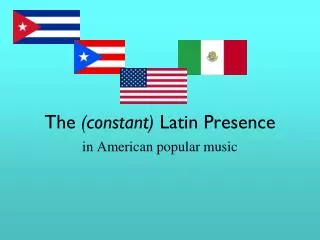
The (constant) Latin Presence in American popular music
Afro-Cuban jazz • Constant contact and cultural exchange between Cuba, New Orleans, New York up to revolution • Influences as early as ragtime • U.S. big-band swing & jazz era, 1940s-1950s • Dizzy Gillespie & Chano Pozo, “Manteca,” 1947
1950s – “Latin” or “tropical” music • I Love Lucy, 1951-1960, and then syndication forever (clip, 6 min) • Tito Puente, “Mambo Gozon”1958 timbales
1950s – early rock’n’roll • Richie Valens, “La Bamba,” 1958 youtube • Buddy Holly “Not Fade Away” 1957 youtube • clavé rhythm (compare to Cuban rumba) • Bo Diddley, “Bo Diddley,” 1955 youtube • Surf music examples
early 1960s – still there, under all that rock • West Side Story (Broadway, 1957; hit film & soundtrack album, 1961) (Dudamel 2007) • The Beatles “And I Love Her” or “I’m Just Happy to Dance with You” from Hard Day’s Night, 1964 • #2 album in 1964 – Getz/Gilberto bossa nova Astrud!
1970 • Santana, “Oye Como Va” 1970 (Garofalo p. 215) youtube • Tito Puente, “Oye Como Va”, 1963 youtube
late 70s & the 80s • Salsa emerges as a genre; influence on disco (percussion breaks, which will later show up in rap) • Gloria Estefan (Miami Sound Machine)