Download
1 / 1
10 likes | 102 Views
Explore the case of a 28-year-old male with incidental CXR abnormalities, revealing cardiomegaly, right heart enlargement, and R pleural effusion. The patient presented with RVH on ECG and RA/RV dilatation on Echo. The CMR study confirmed a Secundum ASD with shunt flow demonstrated by velocity flow map, SSFP cine, and 1st pass SA Gd perfusion during Valsalva. Learn how CMR localizes and quantifies the ASD shunt, differentiating L->R at rest and R->L with Valsalva, while excluding other shunts. Follow this detailed case presentation for insights and diagnosis accuracy.

E N D
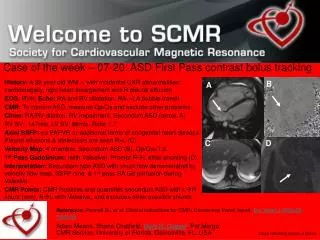
Case of the week – 07-20: ASD First Pass contrast bolus tracking History: A 28 year old WM ♂ with incidental CXR abnormalities: cardiomegally, right heart enlargement and R pleural effusion ECG: RVH; Echo: RA and RV dilatation. RA→LA bubble transit CMR: To confirm ASD, measure Qp/Qs and exclude other problems Cines: RA/RV dilation, RV impairment, Secundum ASD (arrow, A) RV SV: 147mls, LV SV: 88mls. Ratio 1.7 Axial SSFP: no PAPVR or additional forms of congenital heart disease Pleural effusions & atelectasis are seen R>L (C) Velocity Map: 4 chamber. SecundumASD (B). Qp/Qs=1.8 1st Pass Gadolinium: (with Valsalva). Prompt RL atrial shunting (D) Interpretation: Secundum type ASD with shunt flow demonstrated by velocity flow map, SSFP cine, & 1st pass SA Gd perfusion during Valsalva CMR Points: CMR localizes and quantifies secundum ASD with LR shunt (rest), RL with Valsalva, and excludes other possible shunts. B A C D Reference: Pennell DJ et al: Clinical indications for CMR: Consensus Panel report. Eur Heart J 2004;25: 1940-65. Adam Means, Shane Chatfield, Gary R. Cooper, Pat Mergo CMR Service, University of Florida, Gainesville, FL. USA Case handling editor: J Moon